

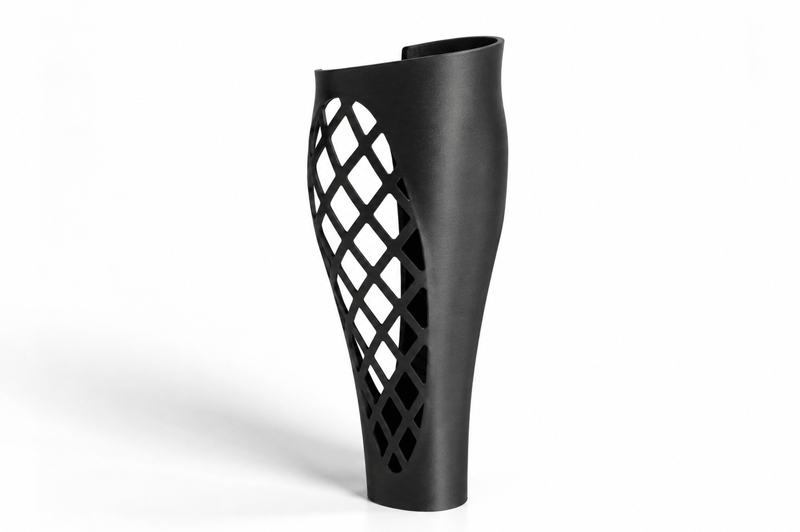
Carbon fiber usually goes into a filament to make parts stiffer. Xenia Materials is now adding it to a material whose value lies in how much it can flex.
At Formnext 2026, the Vicenza-based compounder is launching XECARB® PEBA-CF, an FFF/FDM filament built on a PEBA (polyether block amide) matrix and reinforced with 15% carbon fiber. The target: functional parts that must absorb impacts and mechanical loads, keep deformation under control, and recover their shape afterwards.
A stiffer elastomer
PEBA is a thermoplastic elastomer, valued for its toughness and its ability to release the energy stored during deformation. That flexibility is often a limitation when a part needs to hold its geometry under load. Xenia’s approach is to let the carbon fiber stiffen the matrix, while the elastomeric phase handles toughness and elastic response.
According to the company, XECARB PEBA-CF has a density of 1.08 g/cm³ and a heat deflection temperature (HDT) of 105°C. Xenia positions it for industrial, aerospace and robotics applications, as well as drone and UAV systems, where components must stay light, withstand stress and respond dynamically to it.
The company is increasingly building up expertise in the drones industry. Earlier this year, Xenia supplied a carbon fiber-reinforced polycarbonate to print the autoclave lamination molds of O.L.I.V.I.A., an autonomous fixed-wing drone developed by Politecnico di Milano students for the UAS Challenge 2025. There, the material served as tooling. With PEBA-CF, the ambition shifts toward parts that take the loads themselves.
Looking at Xenia’s 3DF portfolio
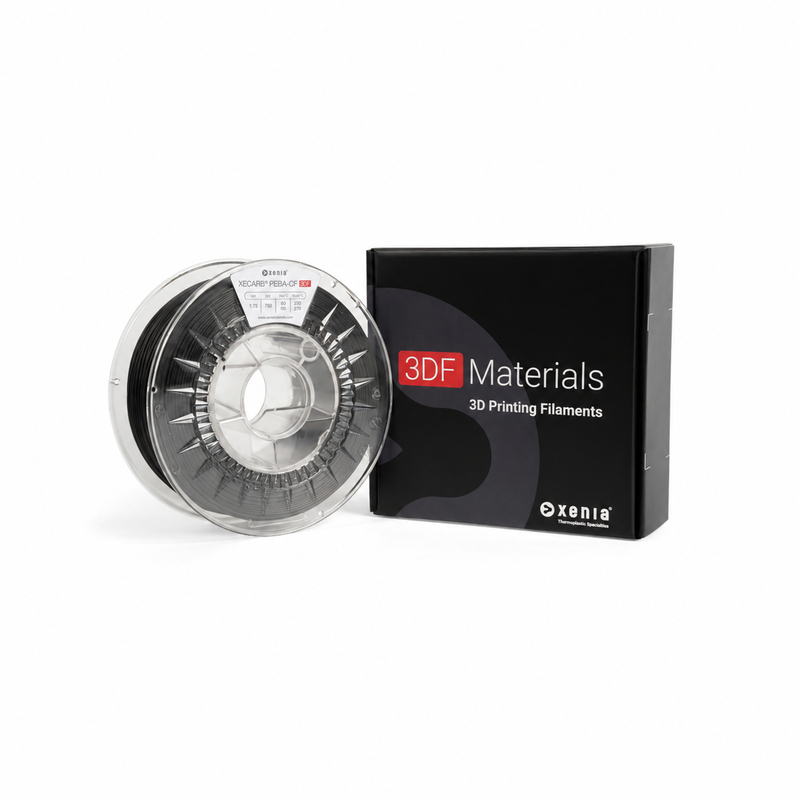
The new grade brings Xenia’s 3DF Materials portfolio to seven filaments. It sits next to XELIGHT® PEBA, an unreinforced, ultra-lightweight PEBA filament designed for flexibility and energy absorption.
The other references are XECARB® PA11-CF-SL, a bio-based PA11 with 15% carbon fiber and a density of 0.99 g/cm³; XECARB® PA12-CF-ST, a “Super Tough” PA12 with 15% carbon fiber; XECARB® PVDF-CF, a 10% carbon fiber PVDF for chemical resistance and electrical conductivity; XEGREEN® PETG-CF, which combines recycled PETG with 20% recycled carbon fiber; and XECARB® PPA-CF, a 20% carbon fiber PPA grade launched in April.
Rather than betting on one flagship material, Xenia is building a range where each polymer answers a different need: weight versus stiffness, toughness versus heat resistance, performance versus recycled content.
THE 3D ADEPT WEEKLY NEWSLETTER Every week, the latest additive manufacturing news, in-depth features and real-world applications, straight to your inbox. Plus, be the first to know when a new issue of 3D ADEPT Mag is out. Free · One email a week · Unsubscribe anytime Clicking loads our email provider’s sign-up form, including its analytics and Google’s anti-bot protection. You’re only subscribed if you complete the sign-up. Read our privacy policy.The industry moves fast. Stay ahead.