

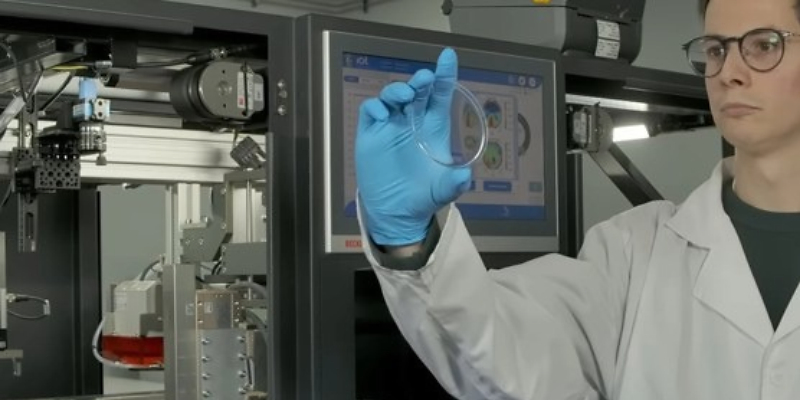
IOT, a company that develops technologies for the ophthalmic lens industry, recently introduced 3D printed personalized progressive lenses. Its process, Light-Form Technology, forms a complete lens with a single flash of light, without layering, generating or polishing.
According to the company, its first commercial application is already reaching consumers with optical partners playing a central role at the heart of IOT’s commercial strategy. The company’s technologies are incorporated into 35 million lenses annually across 70 countries.
Luxexcel had long been almost alone in the niche of 3D printed prescription lenses, until NeoVision shared the possibility of using inkjet technology to produce 3D printed prescription lenses in 2025. Until today, little information has been shared regarding the commercial availability of these lenses.
A closer look at Light-Form Technology
Light-Form is based on stabilized frontal photopolymerization, a method that uses light to form the entire lens volume in one step. The workflow then includes resin recovery to reduce waste, followed by surface hardening and lens mapping. IOT specifies that the lens formation step itself takes seconds, while these subsequent steps complete production.
Using a new production method, the challenge is to be able to reproduce the intended optical design precisely for a personalized progressive lens.
“Light-Form demonstrates how scientific research can change the way ophthalmic lenses are made,” said José Alonso, Co-founder and CINO of IOT. “Combining optical precision with a new manufacturing process opens new possibilities, helping optical partners develop personalized solutions, explore new lens architectures and manufacture with greater flexibility.”
IOT reports that Light-Form eliminates manufacturing water consumption, reduces energy use by 90% and cuts waste by 76% compared with conventional methods. The company notes that these figures refer to manufacturing.
IOT outlines production models built on multiple printing heads for higher output within a compact footprint, as well as compact equipment that could one day enable in-store manufacturing, closer to the wearer and with lower inventory requirements. Another avenue is printing prescription optics directly onto waveguides and flat substrates for smart glasses and augmented reality devices. The company presents these as other business opportunities, distinct from the progressive lenses already reaching consumers.
“The value lies in rethinking the production workflow,” said Carolina Gago, COO of IOT. “Resin recovery and lower water and energy requirements address how resources are used, while compact equipment could support production closer to consumers. We are working to translate these capabilities into practical manufacturing options.”
Let’s see now if Light-Form proves can deliver repeatable optical precision at scale.
THE 3D ADEPT WEEKLY NEWSLETTER Every week, the latest additive manufacturing news, in-depth features and real-world applications, straight to your inbox. Plus, be the first to know when a new issue of 3D ADEPT Mag is out. Free · One email a week · Unsubscribe anytime Clicking loads our email provider’s sign-up form, including its analytics and Google’s anti-bot protection. You’re only subscribed if you complete the sign-up. Read our privacy policy.The industry moves fast. Stay ahead.