Following an analysis of more than 30,000 3D-printed parts to understand how robotics companies are using on-demand manufacturing, Upside Parts found out that 36.7% of parts ordered were produced on a rush schedule compared with 7.2% for hardware & other customers.

According to the custom manufacturing company, nearly a third of production is speed-driven. According to Roman Arkhangelskiy, Founder and Managing Partner of Upside Parts, one reason that could explain that maybe the fact that “robotics teams are about five times more likely to use rush production than other customers, as for them manufacturing speed can affect the engineering schedule. In a sense, lead time becomes more than a purchasing metric. It decides how quickly a team moves to the next physical iteration.”
The trend aligns with the fact that additive manufacturing can shorten lead times by enabling on-demand production in spare parts management. Additionally, orders above 100 parts accounted for 89.0% of the analyzed volume. Around a third of this volume (32.5%) was produced on a rush schedule, compared with 23.8% for orders of 100 parts or fewer. This suggests that the demand for urgency does not fall as order sizes increase.
AMPOWER expects that end-use parts will account for 44% of polymer additive manufacturing applications by 2028. Yet Upside Parts’ data shows that fast turnaround remains important for customers even as they move to larger production runs.
Larger batches still require material flexibility
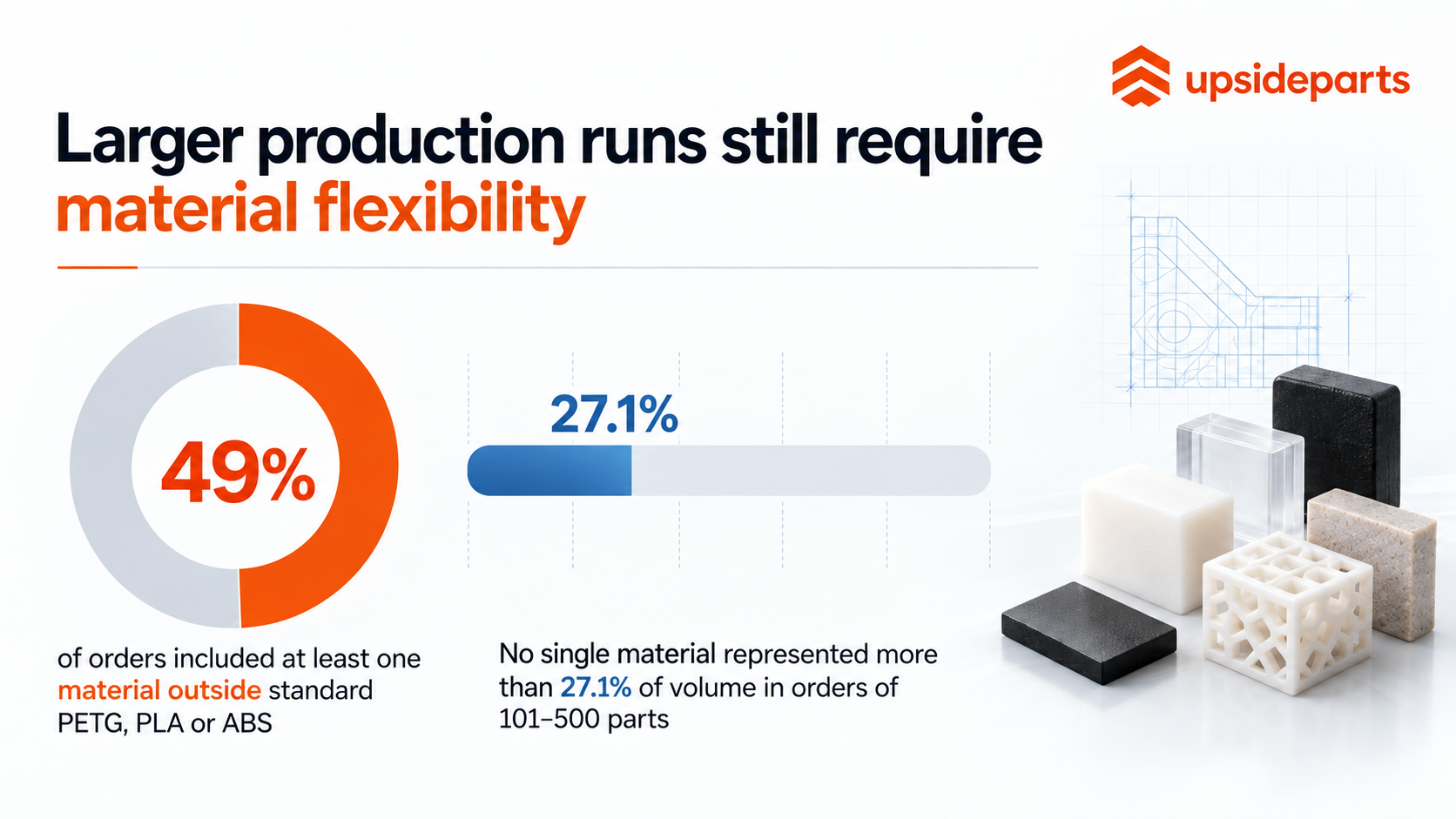
In the production mix, 49% of orders included at least one material outside standard PETG, PLA or ABS. In orders of 101 to 500 parts, no single material accounted for more than 27.1% of volume.
“What stands out is how often engineers need to go beyond the most common plastics. This is not a niche requirement limited to unusual projects. It is part of routine material selection, and the same need shows up in production runs of hundreds of parts,” commented Roman Arkhangelskiy, Founder and Managing Partner of Upside Parts.
Custom parts do not make every element of production unique. Nineteen recurring production combinations accounted for 97.4% of all parts in the dataset. The geometry may change from order to order, but many of the underlying production decisions are familiar.
That creates an opportunity for automation. Repeatable production paths can be standardized and accelerated, while engineers focus on unusual materials, complex geometry and other exceptions.
For manufacturers, the next challenge will be about reducing the time between an approved order and the start of physical production.
*We curate insights that matter to help you grow in your AM journey. Receive them once a week, straight to your inbox. Subscribe to our weekly newsletter.