

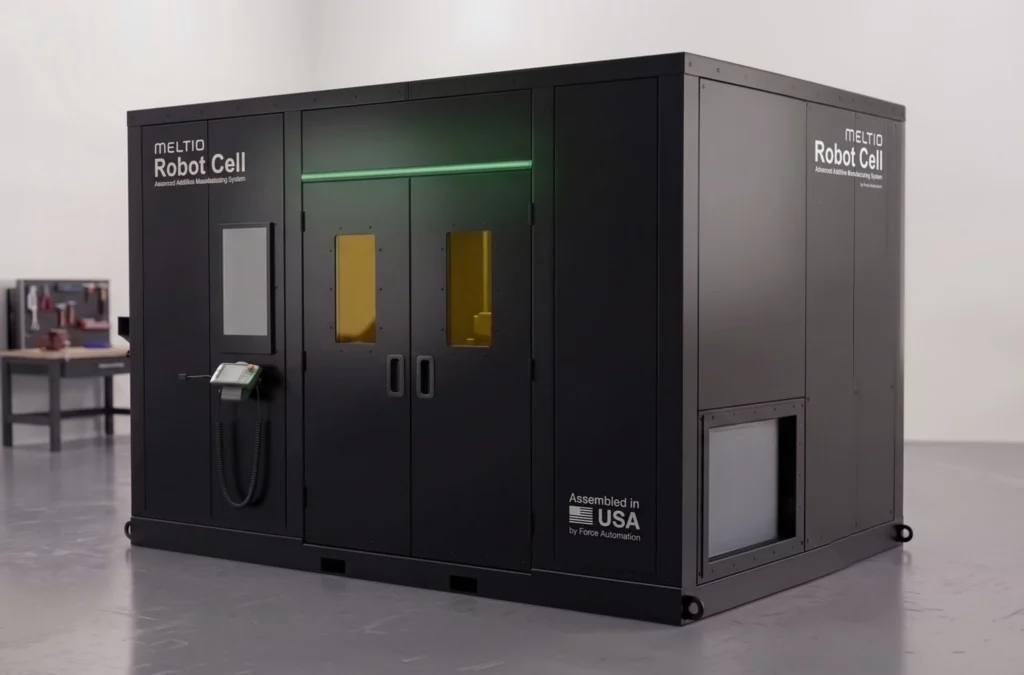
Designed for the US market, Meltio’s new wire-laser metal advanced manufacturing machine, powered by the company’s patented technology, aims to support customers across the automotive, defense, aerospace, mining, energy, and oil and gas industries, among others, with the production of metal parts.
The USA-assembled Meltio Robot Cell is compatible with Meltio’s open hardware platform, enabling the integration of Meltio’s metal 3D printing head with industrial ABB robotic arms.
With these robotic arms, the robot cell ensures a safer, more reliable, and highly accurate way to control the entire process. It works with the company’s slicing software, Meltio Space.
“The Meltio Robot Cell is based on an open hardware platform that enables Meltio’s metal 3D printing head to be integrated with robotic arms from any brand. The volume and work area defined within the Meltio Robot Cell workspace are designed to meet a wide range of manufacturing needs, while Meltio’s industrial-level additive manufacturing technology enables autonomous part production through integrated monitoring and safety features,” Gabriel Ortiz, Meltio North America Sales Manager, notes.
The company emphasizes that the integration with these robotic arms could not have been done without the support of its long-time partner, FORCE Automation Inc., a U.S.-based automation company with extensive expertise in robotic integration. FORCE Automation has been a key partner in supporting the integration of Meltio’s metal 3D printing technology with ABB robotic arms in the U.S. market.
The system is designed as a plug-and-play solution, requiring only a single electrical power connection and a single inert gas supply. It is designed to operate in standard industrial environmental conditions within a controlled, indoor environment. The cell is not intended for outdoor use or exposure to direct sunlight, dust, or other uncontrolled environmental conditions, Meltio explains.
That said, the decision to assemble in the USA could also be seen as a strategic move to adjust to tariff measures and reduce the complexities of the supply chain, as discussed in this dossier.
Alejandro Nieto, Meltio Product Manager, states: “This solution allows the customer to receive a product ready to use for robotic metal 3D printing and reduces all the transportation costs. This new hardware system allows the customer to receive a cell for robotic metal 3D printing, removing the integration process and long assembly lead times. The Meltio Robot Cell has a specific area for every supply the cell requires daily; only connecting to the inert gas and electric supply is enough to start manufacturing.”
THE 3D ADEPT WEEKLY NEWSLETTER
The industry moves fast. Stay ahead.
Every week, the latest additive manufacturing news, in-depth features and real-world applications, straight to your inbox. Plus, be the first to know when a new issue of 3D ADEPT Mag is out.
Free · One email a week · Unsubscribe anytime
Clicking loads our email provider’s sign-up form, including its analytics and Google’s anti-bot protection. You’re only subscribed if you complete the sign-up. Read our privacy policy.