


“These headaches and coughs are getting a bit out of control.”
That single thought was the realization that sparked an 18-month journey of hard work, sweat, and sometimes tears for me and a fellow aerospace engineering student. We realized that our favorite hobby was making us sick.
Let’s take a moment to look at the invisible problem in the maker’s room. To 3D print an object, plastic filament is melted by the hotend, which emits particulates into the air. The most common filament, PLA, releases lactide, which is relatively safe in low concentrations. However, when you step up to engineering-grade filaments, the risks skyrocket. The chemicals emitted become carcinogenic (styrene for ABS) and highly irritant (caprolactam for Nylon).
Editorial note: Health risks depend on the material, printing conditions and exposure. IARC classifies styrene as probably carcinogenic to humans (Group 2A). NIOSH recommends emission controls, including appropriate ventilation and filtration. This guidance does not validate Clura’s filtration percentage or fire-detection claims. Sources: IARC and NIOSH.
Enter Clura: The solution we built. We searched the market for an affordable, open-source solution to protect ourselves, but we couldn’t find one that fit our needs. So, we built our own.
Meet Clura, a smart, modular, and fully open-source enclosure for 3D printers.
This isn’t just a flimsy tent with a duct strapped to the back. Clura is an open-source platform designed to filter air, monitor your environment, and illuminate your workspace—all controlled from a sleek 4.3” touchscreen driven by a custom STM32 motherboard.
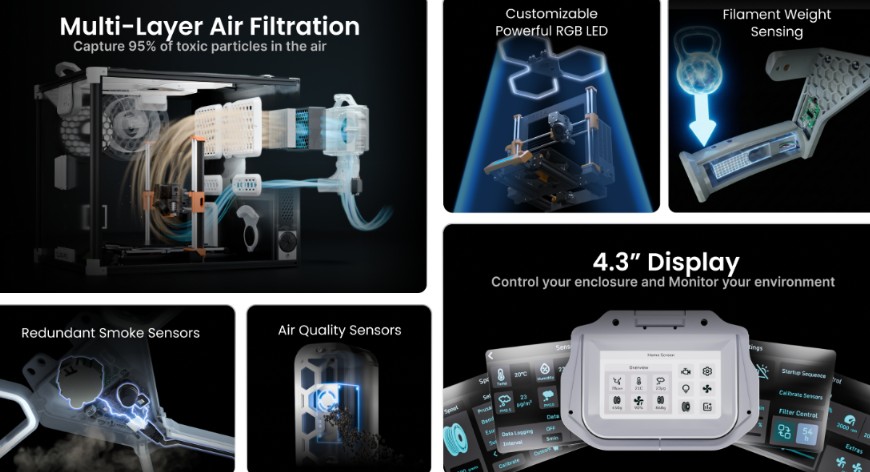
More than just a box
- Advanced filtration: A HEPA and carbon filtration system automatically adjusts airflow based on live sensor data.
- Safety first: Triple-redundant smoke and gas sensors ensure early fire detection.
- Smart monitoring: Load-cell spool holders track your filament weight in real-time, so you never run out mid-print again.
- Total control: From RGB lighting to extra fan ports for motherboard cooling, everything is at your fingertips.
Why completely open-source? You might wonder why we spent so much time on this just to give the files away for free. Building things is what drives me to wake up every day. I wanted to give back to the open-source community that has given me so much.
All CAD files, firmware, schematics, and assembly guides are available on our GitHub. Whether you run a Prusa Mk3/Mk4/Mini, a Bambulab A1/A1 Mini, an Anycubic Kobra, or an Ender 3 style printer, Clura is designed to be adapted to your setup.
Join the campaign today! Our Kickstarter campaign is officially live. Whether you want the full plug-and-play kit, the standalone electronics to build it yourself, or simply want to back the project to support open-source development, we have a tier for you.
Our ultimate goal is simply to see makers using our work to print smarter and safer.
Want to see how it works under the hood? Visit docs.clura.dev to explore the documentation and start planning your build!
This article has been written by Fabrizio Blasio, Lead engineer & Founder of Clura.
THE 3D ADEPT WEEKLY NEWSLETTER
The industry moves fast. Stay ahead.
Every week, the latest additive manufacturing news, in-depth features and real-world applications, straight to your inbox. Plus, be the first to know when a new issue of 3D ADEPT Mag is out.
Free · One email a week · Unsubscribe anytime
Clicking loads our email provider’s sign-up form, including its analytics and Google’s anti-bot protection. You’re only subscribed if you complete the sign-up. Read our privacy policy.