

We’ll be honest: when a company claims it has cracked support-free metal additive manufacturing for complex titanium aerospace components, within a standard LPBF environment, we pay attention.
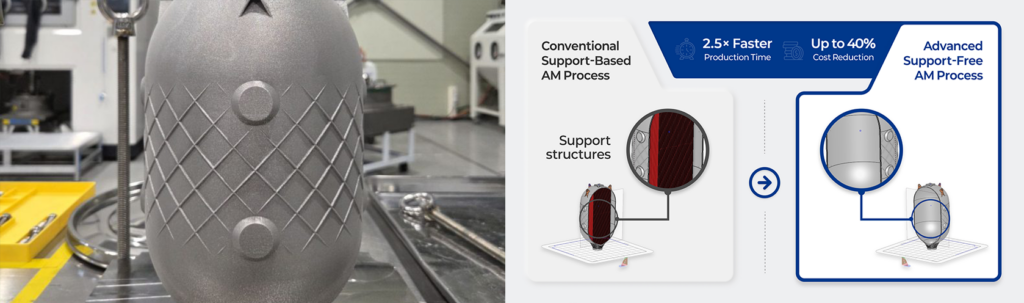
South Korean aerospace company INNOSPACE recently announced it has become the first in the country to commercialize a support-free metal AM process for high-precision titanium parts. The process targets satellite propellant tanks and defense components. The reported results are striking: production time cut by 2.5x and costs reduced by up to 40%. Perhaps most importantly, INNOSPACE also reports significantly enhanced design freedom for curved and dome-shaped geometries that conventional LPBF processes struggle with.
As you may know, titanium is notoriously prone to thermal distortion. Eliminating support structures without compromising structural integrity requires exceptionally sophisticated process control.
INNOSPACE claims to have solved this by leveraging process knowledge accumulated through its HANBIT launch vehicle program.
A familiar ambition, a different industrial context
Interestingly, those who have followed Velo3D’s trajectory will remember the ambition behind the Sapphire platform (low-angle printing, minimal supports, geometric freedom for propulsion components).
Velo3D attracted serious aerospace customers and flew titanium parts in Boom Supersonic’s XB-1. It also built a compelling narrative around support-free printing as the enabler of next-generation rocket and satellite hardware. The company’s subsequent financial difficulties don’t diminish the validity of the technical vision. If anything, INNOSPACE’s announcement suggests that vision was well-placed.
The difference, for now, is context. INNOSPACE is commercializing this within a specific industrial ecosystem, backed by validated real-world supply to a domestic aerospace customer in late 2024.
It is still unclear whether this translates beyond South Korea’s defense and space sector. But in a market projected to grow from $21.9B to over $145B by 2034, being first to commercialize a high-barrier process, in titanium, for aerospace, draws attention.
The question now is: what happens next?
THE 3D ADEPT WEEKLY NEWSLETTER
The industry moves fast. Stay ahead.
Every week, the latest additive manufacturing news, in-depth features and real-world applications, straight to your inbox. Plus, be the first to know when a new issue of 3D ADEPT Mag is out.
Free · One email a week · Unsubscribe anytime
Clicking loads our email provider’s sign-up form, including its analytics and Google’s anti-bot protection. You’re only subscribed if you complete the sign-up. Read our privacy policy.