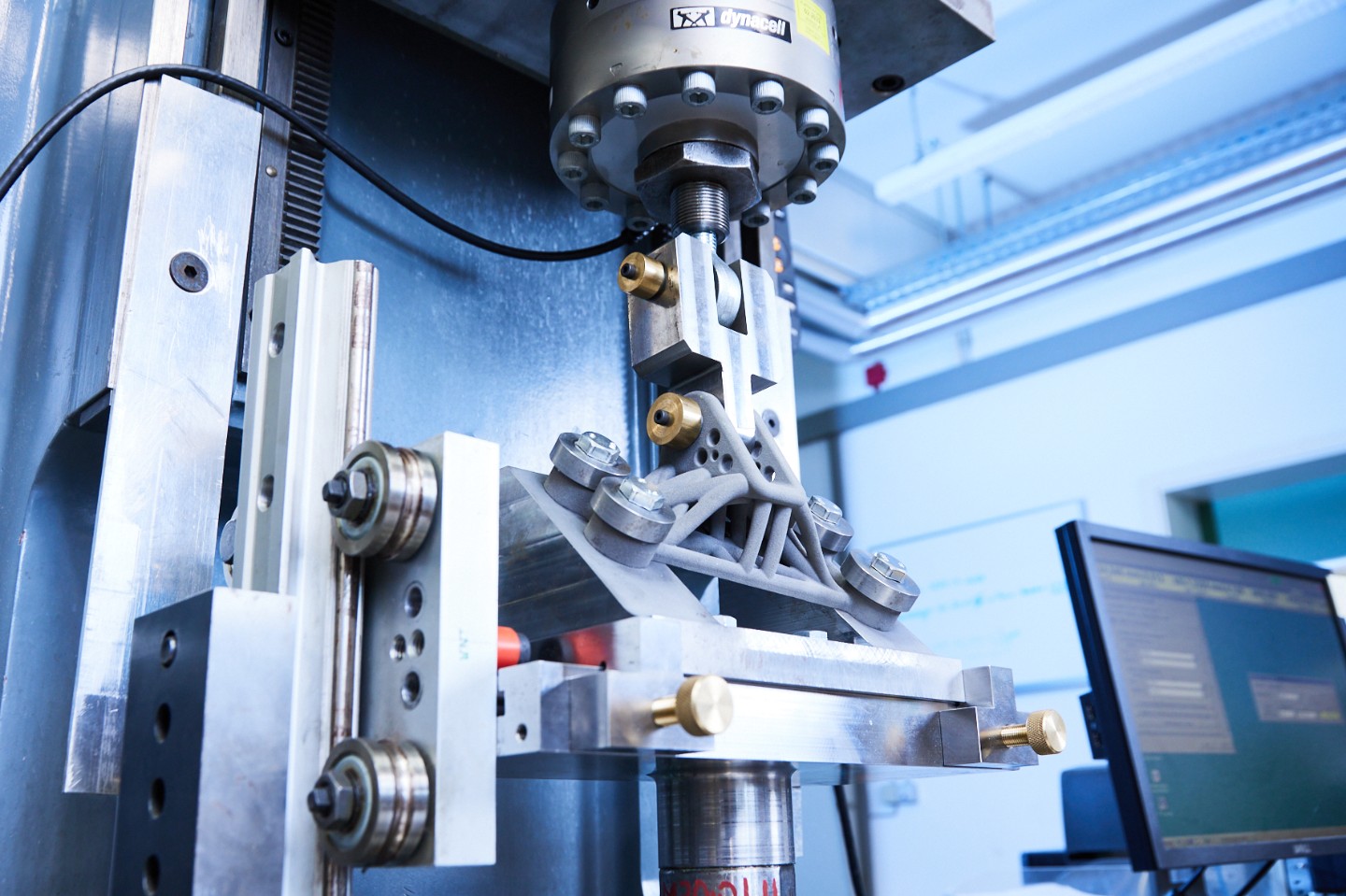
When a metal part is 3D printed, it comes out of the machine with weaknesses concentrated at its surface: roughness, tensile residual stress locked in during printing, and small internal defects such as gas pores.
In a part that is loaded over and over again (for example, an engine component, an aircraft bracket, or a suspension arm) those weaknesses become the starting points for cracks. This is fatigue failure, and it is a key reason printed metal parts have struggled to reach safety-critical applications in aerospace, automotive and energy.
Manufacturers can counter it with mechanical surface treatments: shot peening (blasting the surface with small media), burnishing and deep rolling (pressing or rolling a hard tool across it). All three harden the surface layer and lock compressive stress into it, which makes cracks much harder to start.
The problem is that no practical calculation model existed for applying these treatments to printed parts. Engineers knew the methods worked, but not how to predict the effect of a given set of parameters on a given component, so each part meant another round of physical testing.
Fraunhofer IWM has now closed that gap with a model-based calculation chain: select the treatment based on where the component is most stressed, simulate what the process does to the surface layer, then feed that into a fatigue life assessment built on the FKM guidelines already used across German industry.
Validated on AlSi10Mg, 316L and Ti6Al4V, the institute reports fatigue strength gains of up to 40 percent, calculated in advance, before a single part is treated.
The most immediate value lies at the pre-development stage because the whole chain is computational, engineers can compare several post-treatment strategies (peening pressure, contact force, path overlap) and see the predicted effect on service life before a first component is ever built or tested.
Fraunhofer IWM also points to a second benefit that matters in production: since printed parts overwhelmingly fail at the surface, a tailored post-treatment can partly absorb the batch-to-batch variation that still dogs the printing process itself. And because the process simulation works from fundamental properties such as yield strength and tensile strength, the institute says the approach can be extended to alloys beyond the three it was validated on.
According to the researchers, the barrier was never the treatments themselves but the missing link between process parameters and service life, and the absence of a way to verify the resulting fatigue life. With the new approach, they say, they are opening new possibilities for novel applications.
Project funding
The project results were produced within the project Mechanical Surface Post-Treatment of Additively Manufactured Metal Components for the Targeted Improvement of Fatigue Strength (funding reference IGF 22833 N), funded by the Federal Ministry for Economic Affairs and Energy (BMWE), and were subsequently extended and expanded.
*We curate insights that matter to help you grow in your AM journey. Receive them once a week, straight to your inbox. Subscribe to our weekly newsletter.