Here is its framework.
One of the concerns of aerospace and defense manufacturers is to figure out whether a difficult part can move from concept to repeatable, production‑ready process with the dimensional control, material performance, and manufacturing discipline required in a high‑consequence environment.
For metal and ceramic applications especially, the main challenge remains to assess how powder behavior, densification, shrinkage, support generation, post‑processing, and inspection interact to determine whether a part can be qualified and produced consistently.
Arc Impact, the company that acquires Desktop Metal, addresses these challenges through its AM2 Production framework. Through this route, the company works with manufacturers to define the application, engineer the workflow, and prove that a given route to production can meet technical and business requirements.
What is AM2 Production?
AM2 Production focuses on the entire manufacturing workflow inclusive of materials development, applications development, evaluating candidate parts, optimizing part designs, manufacturing work cell implementation, validating both technical performance and the business case, and then scaling into sustained production, Arc Impact explains.
In practice, this extends beyond the as‑printed part to include upstream and downstream steps, such as powder selection, sintering strategies, machining, and finishing, so that manufacturers are qualifying a complete path to the final component, not just a build file.
One reason this approach is necessary is that aerospace and defense programs often fail or stall because the process around the part to be made is not stable enough to validate. AM2 Production addresses this by structuring adoption as a staged pathway that begins with benchmarking and initial qualification, then moves through workflow optimization, technical and business validation, and finally production deployment and scale‑up.
The example of Silicon Carbide
Silicon carbide is a clear example of why this application‑first strategy matters. Advanced ceramics such as silicon carbide sit at the intersection of demanding material behavior, tight tolerances, and harsh thermal and mechanical conditions, making them difficult to address with conventional manufacturing routes.
That combination is even more important for aerospace and defense applications that must remain dimensionally stable and mechanically robust under vibration, high temperature, and rapid thermal cycling.
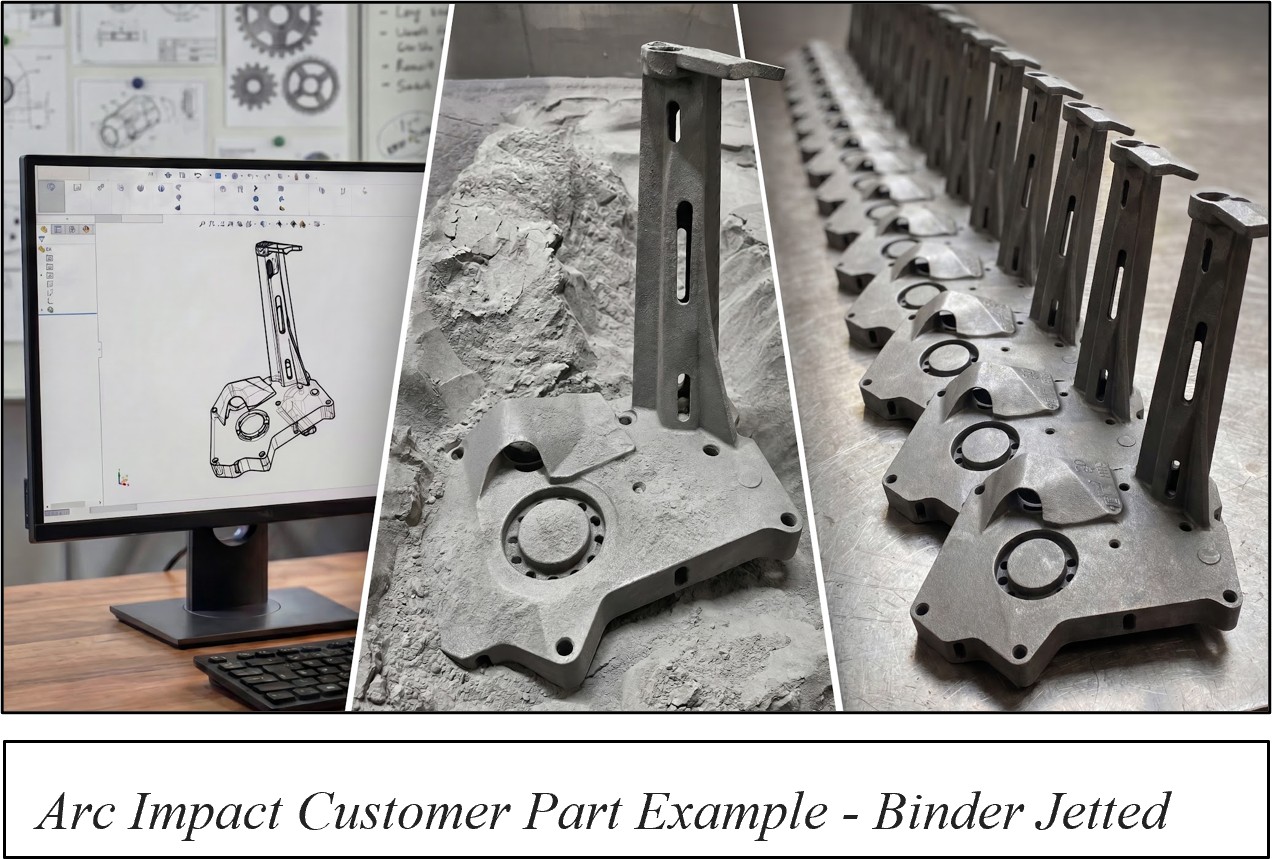
Across applications ranging from space‑borne optics to high‑temperature thermal management and protection systems, including components for propulsion, sensing, and survivability, Arc Impact positions its X‑Series binder jet systems around the densification of complex metallurgical and ceramic systems.
The X-Series systems can process non‑oxide ceramics such as silicon carbide, with open‑parameter development to fine‑tune powder morphology, binder saturation, and sintering profiles. The goal is not simply to demonstrate that silicon carbide can be printed, but to qualify robust manufacturing paths for high‑value components on which it depends.
Within this broader solutions framework, the X25Pro™ and X160Pro™ function as complementary platforms that support different stages of application maturity and scale. The X25Pro™ provides a mid‑sized environment well suited to benchmark parts, and early‑phase aerospace and defense programs where the immediate objective is to establish process understanding, refine densification behavior, and build confidence in dimensional outcomes. Once a workflow has been proven out, the X160Pro™ carries the same binder jet logic into a larger production envelope, enabling larger parts, larger batches, or arrays of parts when the conversation shifts toward throughput, cost per part, and supply‑chain resilience.
That progression is important because all aerospace and defense applications do not pose the same challenges at the same time. Early on, the challenge may be proving that a difficult geometry in metal or technical ceramic can be processed within specifications to justify further investment.
Later, the emphasis may shift to demonstrating that once a material and geometry are understood, the workflow can scale without losing dimensional control or throughput efficiency. By mapping applications across the AM2 Production pathway and deploying the X25Pro™ and X160Pro™ where they add the most value, Arc Impact gives manufacturers a way to move from first article to serial production without changing the underlying manufacturing logic.
The same application‑driven philosophy extends to process control and measurement. Arc Impact surrounds its binder jet platforms with a broader Live Suite software production environment designed to improve part accuracy and support scan‑based deformation correction and tolerancing, so that dimensional performance after sintering can be predicted and managed with production scale tolerance tracking rather than left to trial and error.
This is often where a promising additive concept either becomes a manufacturable reality or fails to meet validation criteria, and where partnering with Arc Impact can mean the difference between a single prototype build and a qualified, production‑ready solution.
*We curate insights that matter to help you grow in your AM journey. Receive them once a week, straight to your inbox. Subscribe to our weekly newsletter.