

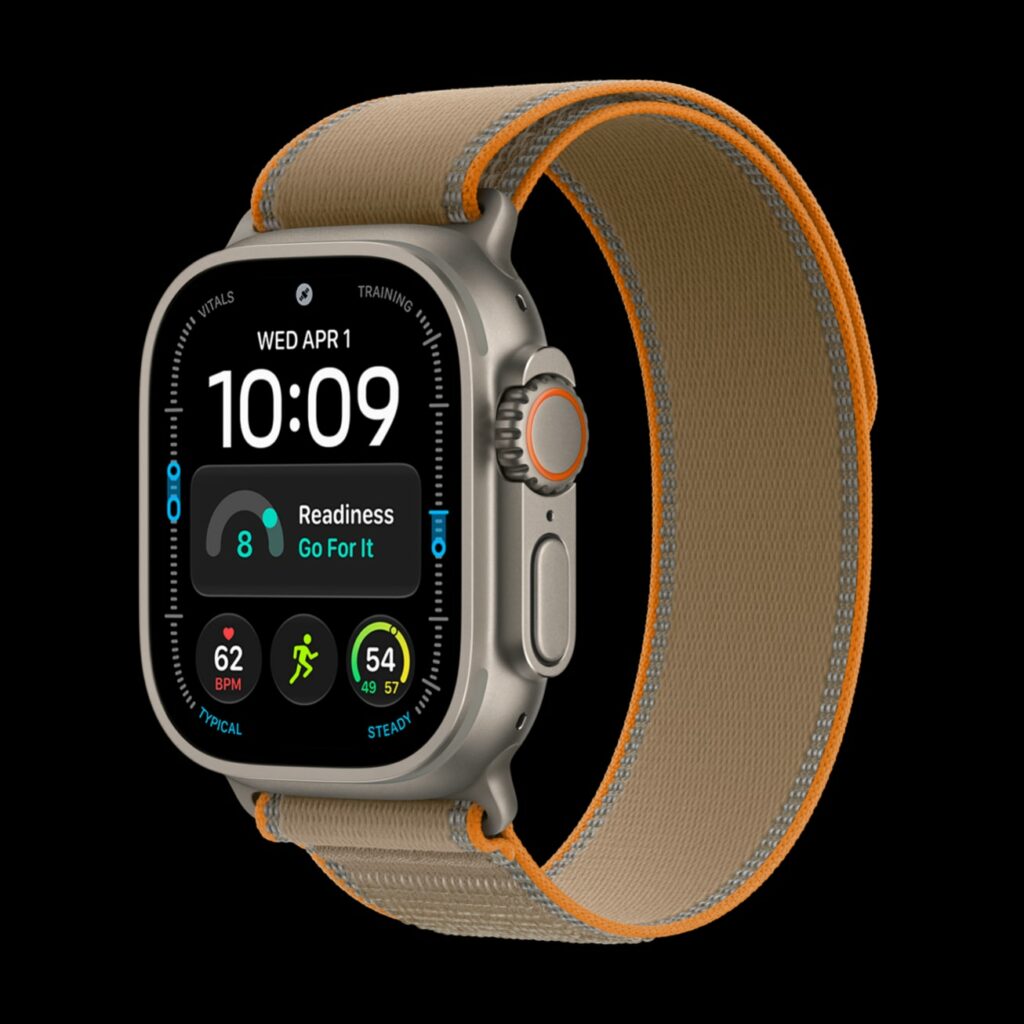
Alongside the iPhone Duo, its first foldable, whose grade 5 titanium enclosure carries a 3D printed hinge cover, Apple released its Apple Watch Ultra 4, reinforcing its commitment to building environmentally friendly products.
The watch uses 45 percent recycled material overall. This includes 100 percent recycled titanium in its 3D printed titanium case and 100 percent recycled cobalt in the battery.
According to the company, renewable energy supplies the electricity used to manufacture the watch across the supply chain. The watch comes in natural and black titanium, starts at $799 and reaches stores this week, as of 18 September.
Qualification and titanium savings at production scale
As a reminder, last year, the company moved the entire case production of Apple Watch Ultra 3 and of the titanium Series 11 to 3D printing, using 100 percent recycled aerospace-grade titanium powder. Meanwhile, the iPhone Air received a 3D printed titanium USB-C port.
3D printing a structural case for a device that must be water resistant, drop tested and dimensionally identical across millions of units underscores how crucial qualification is here to deliver the promise.
And to achieve that, Apple placed a key focus on the selected material: half the raw titanium per case, and more than 400 metric tons of raw titanium saved in 2025, according to Apple’s figures for the Ultra 3 and titanium Series 11.
While Apple has described the printing process used for its 2025 watch cases, the Ultra 4 announcement does not name the exact machines or suppliers. We can’t help but think that maybe Apple is becoming the adidas of our industry.
Ever since adidas started using AM, it has kept releasing products built with the technology, at least one per year, usually in a limited collection. Apple now looks similar. The only difference—and it is not a small one—is that Apple mass-produces the product. It does not offer limited collections as adidas does.
That said, the question we raised about the hinge cover applies here too: Was additive chosen for the aesthetic, for the material savings, or because the part could not be made any other way?
Source: Apple — titanium watch cases, 18 November 2025.
THE 3D ADEPT WEEKLY NEWSLETTER
The industry moves fast. Stay ahead.
Every week, the latest additive manufacturing news, in-depth features and real-world applications, straight to your inbox. Plus, be the first to know when a new issue of 3D ADEPT Mag is out.
Free · One email a week · Unsubscribe anytime
Clicking loads our email provider’s sign-up form, including its analytics and Google’s anti-bot protection. You’re only subscribed if you complete the sign-up. Read our privacy policy.