Matthäi Schlüsselfertigbau has established its own construction 3D printing division. Matthäi Schlüsselfertigbau is a subsidiary of the German construction giant Matthäi, with over 3,300 employees and more than EUR ~1 billion in revenue.
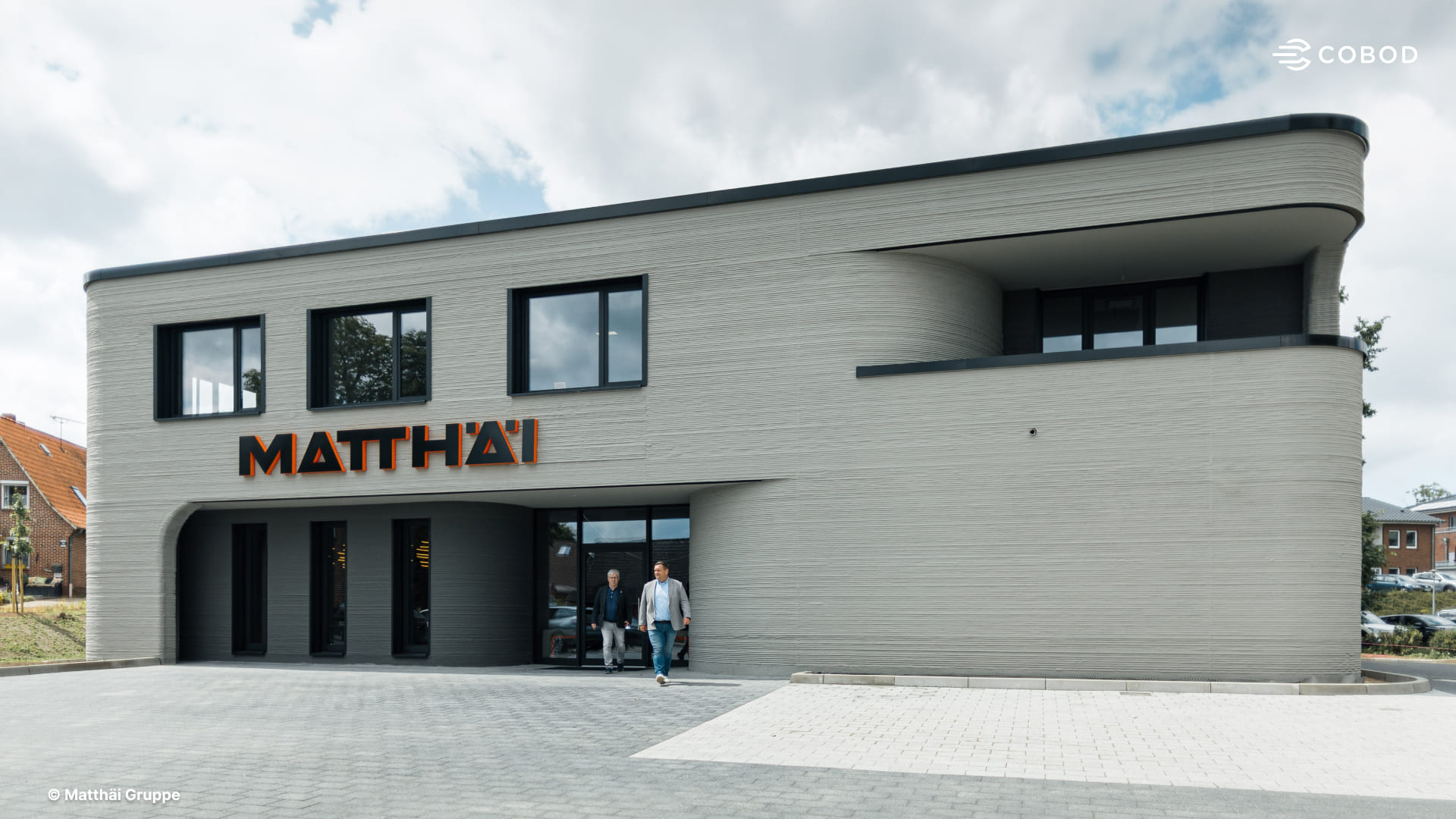
The decision followed the successful completion of the company’s new two-story headquarters of 364 m² (3,920 SF) in Selsingen, Lower Saxony, printed with a COBOD BOD2 construction 3D printer and occupied in July 2026.
“The entire Matthäi Group is proud to be able to realize the first 3D-printed building in Northern Germany. Together with our partners at PERI 3D Construction, we are taking an important step into the future of construction. Once again, this shows how strongly Matthäi combines entrepreneurial growth with innovation and progress,” said Bernd Mergard, Managing Director of Matthäi Schlüsselfertigbau.
The new 3D printed two-story
The building measures around 7.4 m (24 ft) high, 22.5 m (74 ft) long and 13.5 m (44 ft) deep, printed across two full storeys. It provides 364 m² (3,920 SF) of usable space, with 170 m² (1,830 SF) on the ground floor and 194 m² (2,090 SF) on the first floor.
The walls of the ground floor and upper floor together took about 105 hours of printing time using Holcim’s TectorPrint, a printable cementitious material. The foundation, base slab, floors and roof were built using conventional methods.
The building’s form and facade were designed by the architectural office Schulenburg together with the planning firm Mense-Korte.
“3D concrete printing allows us to completely revolutionize traditional construction processes. As a company, we see in this innovation not only a technological advance, but the creation of an entirely new sector within construction. With this technology we are shaping the future of building: faster, more flexible and more sustainable,” said Tim Schulenburg, Managing Director of Schulenburg Architekten.
After the successful completion of its headquarters, Matthäi established its own construction 3D printing division in partnership with PERI 3D Construction, its technology partner on the project. What began as a single printed building has become part of the company’s regular business.
“Matthäi printed a two-story office building and then set up its own printing division. That step, from one project to an in-house capability, is exactly what we want to see. It shows construction 3D printing has moved from demonstration into everyday business,” said Philip Lund-Nielsen, Co-founder & CCO of COBOD International.
*We curate insights that matter to help you grow in your AM journey. Receive them once a week, straight to your inbox. Subscribe to our weekly newsletter.