

Antimicrobial additives are being explored for some 3D printing filaments. This contribution from Addmaster explains potential mechanisms and applications. Activity measured on a material does not by itself establish protection of users’ health or efficacy for every printed object.
Performance depends on the additive, polymer, concentration, printed surface and exposure conditions. Testing should address the final object; treatment does not replace cleaning appropriate to the application.
Additives can be incorporated into the polymer during filament production to limit certain microorganisms on the material. The organisms targeted and conditions of effectiveness must be specified by the tests.
The mechanisms by which antimicrobial additives function can vary, but they typically involve one or more of the following processes:
- Disruption of cell membranes: Certain antimicrobial additives can disrupt the cell membranes of microorganisms, leading to the leakage of essential cellular components and ultimately causing cell death.
- Interference with metabolic pathways: Some antimicrobial additives can interfere with crucial metabolic pathways within microorganisms, preventing them from carrying out essential functions and hindering their growth and reproduction.
- Generation of reactive oxygen species: Antimicrobial additives can generate reactive oxygen species (ROS), such as hydrogen peroxide or singlet oxygen, which can damage cellular components and lead to oxidative stress, ultimately killing the microorganisms.
- Inhibition of enzyme activity: Antimicrobial additives may also inhibit the activity of enzymes essential for microbial growth and survival, effectively halting their metabolic processes.
The choice of antimicrobial additive and its mechanism of action largely depend on the intended application, the target microorganisms, and the desired level of antimicrobial efficacy.
Silver-based formulations are among the options investigated. Activity against one bacterium in a given test does not prove effectiveness against all fungi or viruses, or reduced infections among users.
Incorporation of antimicrobial additives into 3D printing filaments
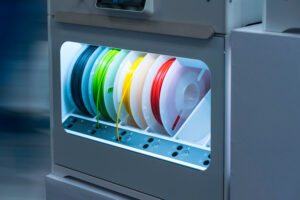
The process of incorporating antimicrobial additives into 3D printing filaments typically occurs during the filament manufacturing stage. The antimicrobial additives are added to the base polymer material, which is then extruded into filament form using specialized equipment.
The incorporation of antimicrobial additives can be achieved through various methods, including:
- Melt compounding: In this process, the antimicrobial additive is mixed with the polymer resin in a molten state, with the aim of achieving uniform dispersion throughout the material. The molten mixture is then extruded into filament form.
- Solvent-based techniques: For polymers that are soluble in specific solvents, the antimicrobial additive can be dissolved or dispersed in the solvent along with the polymer. The resulting solution or dispersion is then extruded or cast into filament form, and the solvent is subsequently removed.
- In-situ polymerization: In this method, the antimicrobial additive is incorporated during the polymerization process of the polymer itself, with the aim of achieving homogeneous distribution within the polymer matrix.
The choice of incorporation method depends on factors such as the compatibility of the antimicrobial additive with the polymer, the desired concentration and distribution of the additive, and the processing conditions required for filament extrusion.
It is essential to ensure proper dispersion and distribution of the antimicrobial additive throughout the filament to achieve optimal antimicrobial efficacy in the final 3D printed product. Additionally, the concentration of the additive must be carefully controlled to strike a balance between antimicrobial performance and potential impacts on the mechanical and physical properties of the printed object.
Applications and strength of evidence
Frequently touched surfaces in transport, equipment and healthcare environments are potential research targets. A laboratory reduction in microorganisms must be distinguished from a benefit under real operating conditions.
Aerospace
The original contribution described silver-filled printed tray tables and armrests in an Airbus–ESA project. No primary reference confirming that specific case, its tests and results was located during editorial review; it is therefore not retained as a demonstrated application.
Separately, ESA’s Biofilms experiment studies bacteria on metal surfaces in space. It does not validate the printed-filament case previously described. Fire performance, compatibility and durability requirements still need to be assessed for each aerospace component.
Automotive and other transport
High-touch interior parts could be investigated, including for shared mobility. Ageing, cleaning and abrasion resistance need to be tested. An additive alone guarantees neither occupant hygiene nor component compliance.
Testing and regulatory context
Qualification depends on intended use, claims and market. ISO 22196 measures antibacterial activity on treated plastics and other non-porous surfaces. Such a result is not general certification of clinical, antiviral or food-safety effectiveness.
In the United States, the FDA evaluates finished medical devices, rather than approving a material for every possible use. In Europe, medical-device legislation applies; EMA’s role covers specific situations, not general approval of all devices.
The US EPA treated-articles exemption concerns protection of the article itself, subject to conditions. It does not automatically permit claims to protect users’ health. In the EU, the treated-articles framework requires checking active substances, permitted uses and applicable labelling requirements.
Aerospace, medical and food-contact applications require product-specific evaluation. An antimicrobial result does not remove the need to establish safety, compatibility and performance.
Development opportunities
Food-processing and agricultural equipment and construction components are possibilities raised by Addmaster. Their value requires appropriate testing, including substance release, ageing, exposure and end-of-life considerations. Food safety or extended shelf life cannot be inferred from the presence of an additive alone.
Collaboration between formulators, manufacturers and laboratories can help compare results using documented protocols. Reports should identify the control material, test organisms, contact time and surface conditions, and explain their relevance to the intended application.
Conclusion
Antimicrobial filaments require assessment of both material and printed part. A 2024 experimental preprint, not peer-reviewed in this version of 3D printing materials illustrates why testing under relevant conditions matters. Expected benefits should remain proportionate to the available evidence.
This article has been written by Addmaster. It has first been published in the 2024 July/August edition of 3D ADEPT Mag.
The contribution has been reviewed and clarified by the editorial team for this version.
THE 3D ADEPT WEEKLY NEWSLETTER
The industry moves fast. Stay ahead.
Every week, the latest additive manufacturing news, in-depth features and real-world applications, straight to your inbox. Plus, be the first to know when a new issue of 3D ADEPT Mag is out.
Free · One email a week · Unsubscribe anytime
Clicking loads our email provider’s sign-up form, including its analytics and Google’s anti-bot protection. You’re only subscribed if you complete the sign-up. Read our privacy policy.