

Design automation can reduce repetitive work when developing complex additive manufacturing parts. Its usefulness depends on the application, the knowledge encoded in the workflow and the constraints of the chosen AM process. Diabatix and an ETH Zurich research example illustrate where it can help.
If we had to explain what design automation is, we would use Dr. Ir. Lieven Vervecken’s words: “Design automation allows product developers, engineers, and designers to incorporate knowledge from various domains into their workflows without needing deep expertise in each area. For instance, using generative design to reduce product mass by introducing lattice structures doesn’t require the designer to be an expert in lattice structures or optimization.”
Vervecken is the founder and CEO of Diabatix, a Belgium-based company developing ColdStream, a software solution that focuses on the automated design of thermal components.
His explanation makes sense when one realizes that knowledge-based systems, and software applications designed for intelligent knowledge capture and use are pivotal to achieve design automation (DA). According to Vervecken, when this knowledge is lacking, attempts to convert conventional designs into AM-suitable ones often fail, [making the design process] time-consuming and hard to automate due to the uniqueness of each part. Therefore, by relying on automated design algorithms, designers can reduce, even remove frequently recurring and time-consuming tasks when designing 3D printed parts.
It can be easy to appreciate the advantages of design automation when assessing different applications. That being said, three areas where DA can be useful include batch processing, design exploration and mass customization.
Design exploration means comparing candidate geometries against specified objectives and constraints. Automation can expand this search, but the resulting geometry still needs engineering checks and validation appropriate to the application.
The example of batch processing seems obvious when one knows that repetitive tasks can be achieved by applying the same design processes to dozens or hundreds of similar parts at the same time. This allows the designer to gain time in engineering design tasks, such as managing product families, assigning unique serial numbers to individual parts, or even meshing numerous parts.
In a mass customization case, for instance, a design automation approach facilitates the generation of different designs based on new inputs over time. Without such an approach, the time to get to market would be delayed as a technician would have to manually process each individual custom order request.
Examples of applications where it makes sense to rely on DA
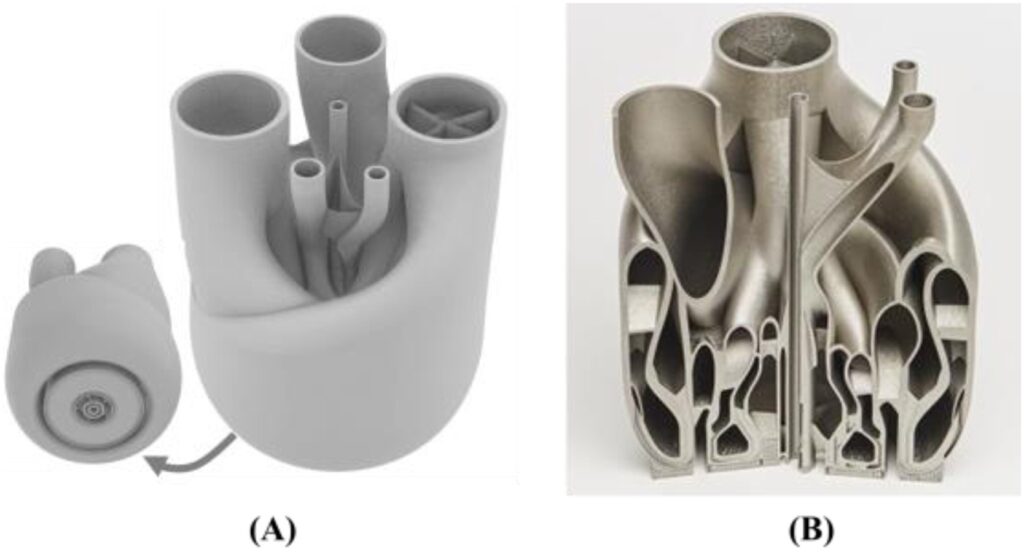
Researchers at ETH Zurich describe a design toolbox for multi-flow nozzles, including cross-section shapes, flow channels, branches, guiding vanes and reinforcement ribs.
The research team explains they “apply these design elements to specify the layout of a nozzle using a high-level definition of the required design elements (e.g., position and shape of channel cross-sections). Based on these intuitive user inputs, design algorithms translate the nozzle layout into a detailed 3D nozzle geometry. In the example, the design toolbox is demonstrated by showing the automated design of different nozzles that are tested using co-extrusion of clay materials.”

On another note, Diabatix has built up expertise in developing automated thermal design in cooling applications. The company has integrated DfAM (Design for Additive Manufacturing) rules into its ColdStream platform powered by generative AI.
“This means designers can create highly efficient heat sinks without needing in-depth knowledge of fluid mechanics or heat transfer. […] For AM, users control DfAM parameters like overhang angles, unsupported bridge lengths, and feature sizes. This flexibility allows adaptation for powder bed fusion, binder jetting, and more, all within the same interface. Collaborations with companies like 3D Systems, Desktop Metal, and Amnovis have demonstrated this flexibility,” the CEO explains.
Diabatix reports improved heat-transfer performance for a copper liquid-nitrogen CPU cooler developed with 3D Systems and partners. Its case-study summary concerns an extreme-overclocking application; that result is not a general performance gain for every automated design.

With the key focus on generative AI as a key strength in the design of this 3D printed liquid nitrogen (LN2) heatsink, one concern we had was to know if design automation features should absolutely be powered by AI. To this question, Vervecken answers:
“No, not necessarily. Most DfAM rules can be translated into mathematical expressions that don’t require AI to evaluate them or to integrate them during a design process. That being said, I do see value in using AI for assessing manufacturability during the preprocessing phase, especially for complex parts. When trained on a proper data set, I can imagine that AI can speed up this time-consuming process by identifying patterns.”
In the end, “design automation is only effective when the design process accounts for the specific AM process’s limitations,” he points out.
Choosing an automation workflow
Learning how to make the most of a design automation approach is important for both beginners and advanced designers in AM who would like to accelerate their learning curve with the technology.
From industrial hardware development to the development of complex parts, all while reducing material waste and automating labor-intensive workflows, design automation tools provide advantages, which as per Vervecken’s words, often come down to three items: “higher reliability through integrated analysis during the design process, reduced human error, and shorter time-to-market due to fewer design iterations.”
These are intended benefits, not guaranteed outcomes. An evaluation should include model assumptions, manufacturability, physical testing, integration effort and the cost of maintaining the design rules.
THE 3D ADEPT WEEKLY NEWSLETTER
The industry moves fast. Stay ahead.
Every week, the latest additive manufacturing news, in-depth features and real-world applications, straight to your inbox. Plus, be the first to know when a new issue of 3D ADEPT Mag is out.
Free · One email a week · Unsubscribe anytime
Clicking loads our email provider’s sign-up form, including its analytics and Google’s anti-bot protection. You’re only subscribed if you complete the sign-up. Read our privacy policy.