

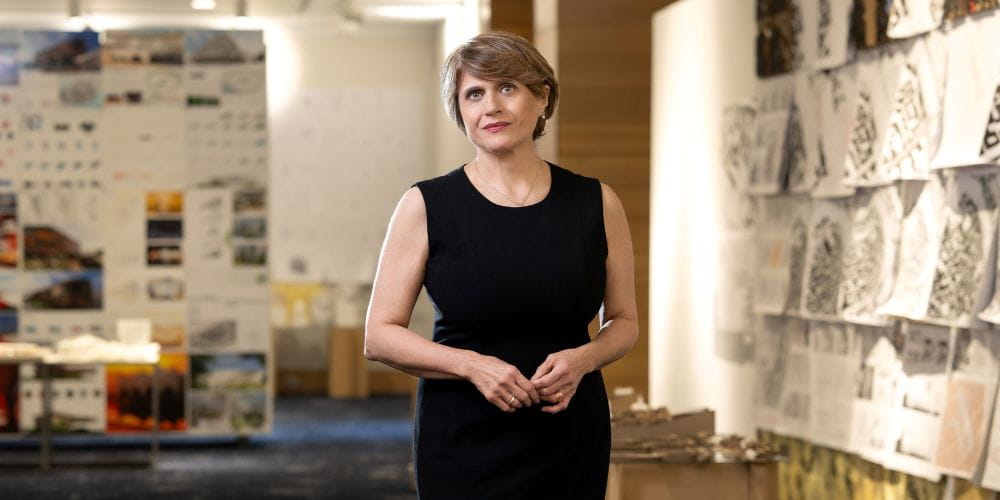
University of Texas at Arlington architecture Professor Shadi Nazarian is a member of an interdisciplinary team exploring the viability of 3D-printing homes in rural Alaska to provide affordable, sustainable and resilient housing.
Nazarian and her team plan to print these homes using a mix of cork and concrete, a unique approach tailored for the frozen grounds in Alaska that makes the structure lightweight and provides excellent insulation. Her eventual goal is to develop seamless transitional material that can print at a large scale, making housing more energy-efficient, affordable and accessible in remote areas.
How the project began
The Alaska project started at the behest of Xtreme Habitat Institute (XHI), an Alaska-based nonprofit corporation that approached Nazarian and her team after their successful participation in the NASA 3D-Printed Habitat Challenge Competition. The competition’s goals were to catalyze the adoption of additive construction technology and develop deployable printing systems that utilized indigenous materials.
Nazarian’s team created a fully enclosed 3D-printed concrete structure without relying on any support structure or formwork during construction.
Research funding and partners
The Alaska project is funded in part by a $1.6 million matching grant program supported by the U.S. Department of Housing and Urban Development, the Denali Commission, the Alaska Housing Finance Corporation and the Rasmuson Foundation. Some of these funds were issued to the remote city of Nome, Alaska, which commissioned XHI to conduct research, testing and demonstration of 3D concrete printing technologies.
XHI is teaming up on the project with X-Hab 3D, a robotic additive concrete manufacturing company Nazarian cofounded that offers printing systems, materials, and designs. Other collaborators include Sven Bilén, Penn State professor and X-Hab 3D cofounder; Nate Watson, X-Hab 3D vice president of engineering and product; and José Duarte, Penn State professor and X-Hab 3D cofounder. Penn State professors Ali Memari and Aleksandra Radlińsk, their respective doctoral students, and the Cold Climate Housing Research Center at the National Renewable Energy Laboratory will also work on the project.
Make sure to follow us on our social networks and subscribe to our weekly newsletter : Facebook, Twitter, LinkedIn & Instagram ! If you want to be featured in the next issue of our digital magazine or if you hear a story that needs to be heard, make sure to send it to contact@3dadept.com
THE 3D ADEPT WEEKLY NEWSLETTER Every week, the latest additive manufacturing news, in-depth features and real-world applications, straight to your inbox. Plus, be the first to know when a new issue of 3D ADEPT Mag is out. Free · One email a week · Unsubscribe anytime Clicking loads our email provider’s sign-up form, including its analytics and Google’s anti-bot protection. You’re only subscribed if you complete the sign-up. Read our privacy policy.The industry moves fast. Stay ahead.