

Archive — Feature published in September 2019 with interviews from Sirris, Renishaw, 3D Systems, Airbus and Bugatti. Roles, equipment limits and development expectations are those of the original interviews.
Aerospace and automotive provide important applications for metal additive manufacturing, with different requirements for cost, production rate and qualification.
The Wohlers Report 2018 announcement described growth of about 21% for the overall AM industry, not metal AM alone. This feature explores metal applications with Benjamin Denayer (Sirris), Martin McMahon (Renishaw), Kay-O Kissling and Michael Sattler (3D Systems), Delphine Carponcin (Airbus) and Frank Götzke (Bugatti).
1.Metal additive manufacturing (AM) in a few words …
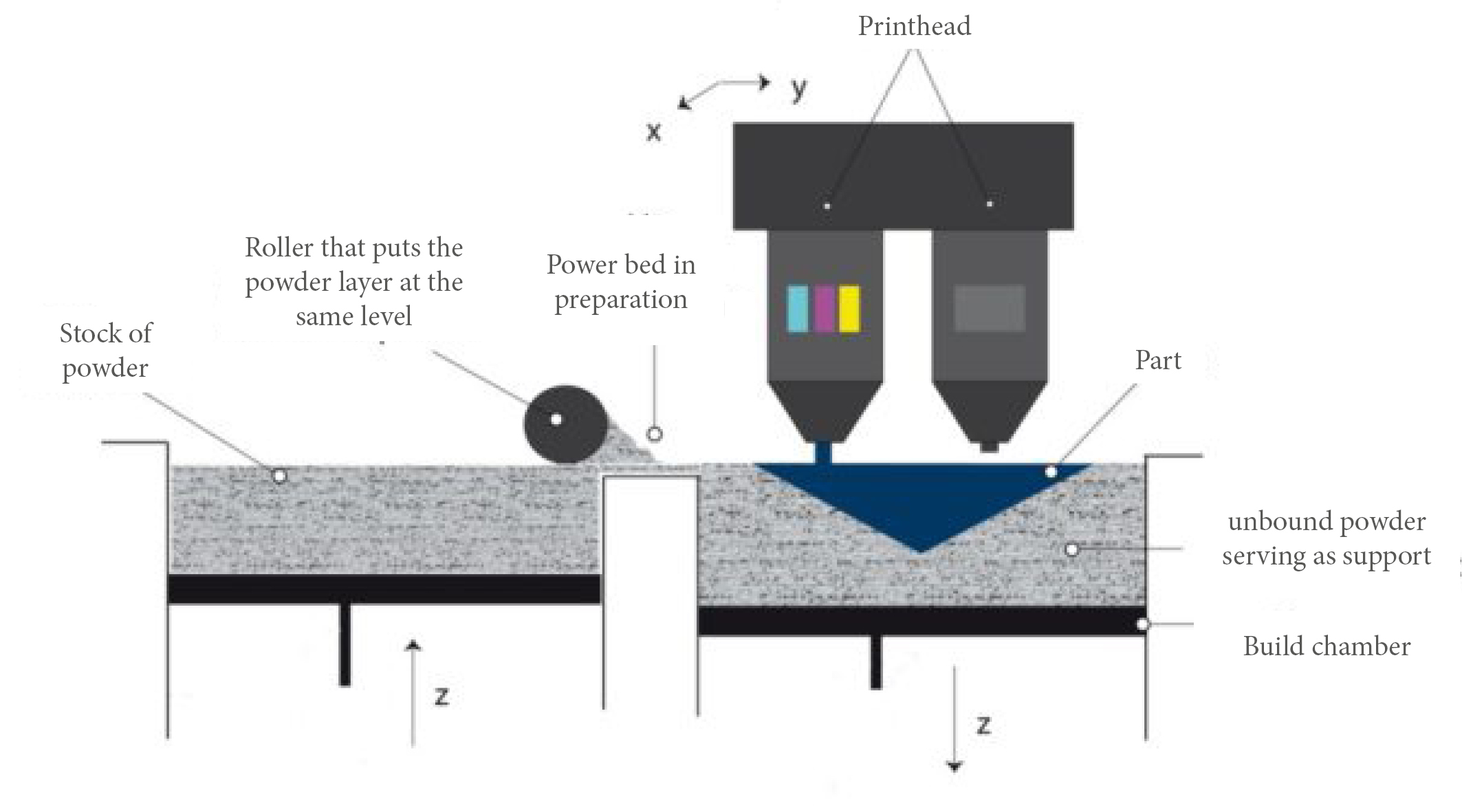
This feature mainly covers powder bed fusion and directed energy deposition. Metal powder bed fusion uses a laser or electron beam to melt selected regions of successive layers. Metal AM also includes other processes, such as binder jetting, illustrated below; that process uses a binder before later consolidation.
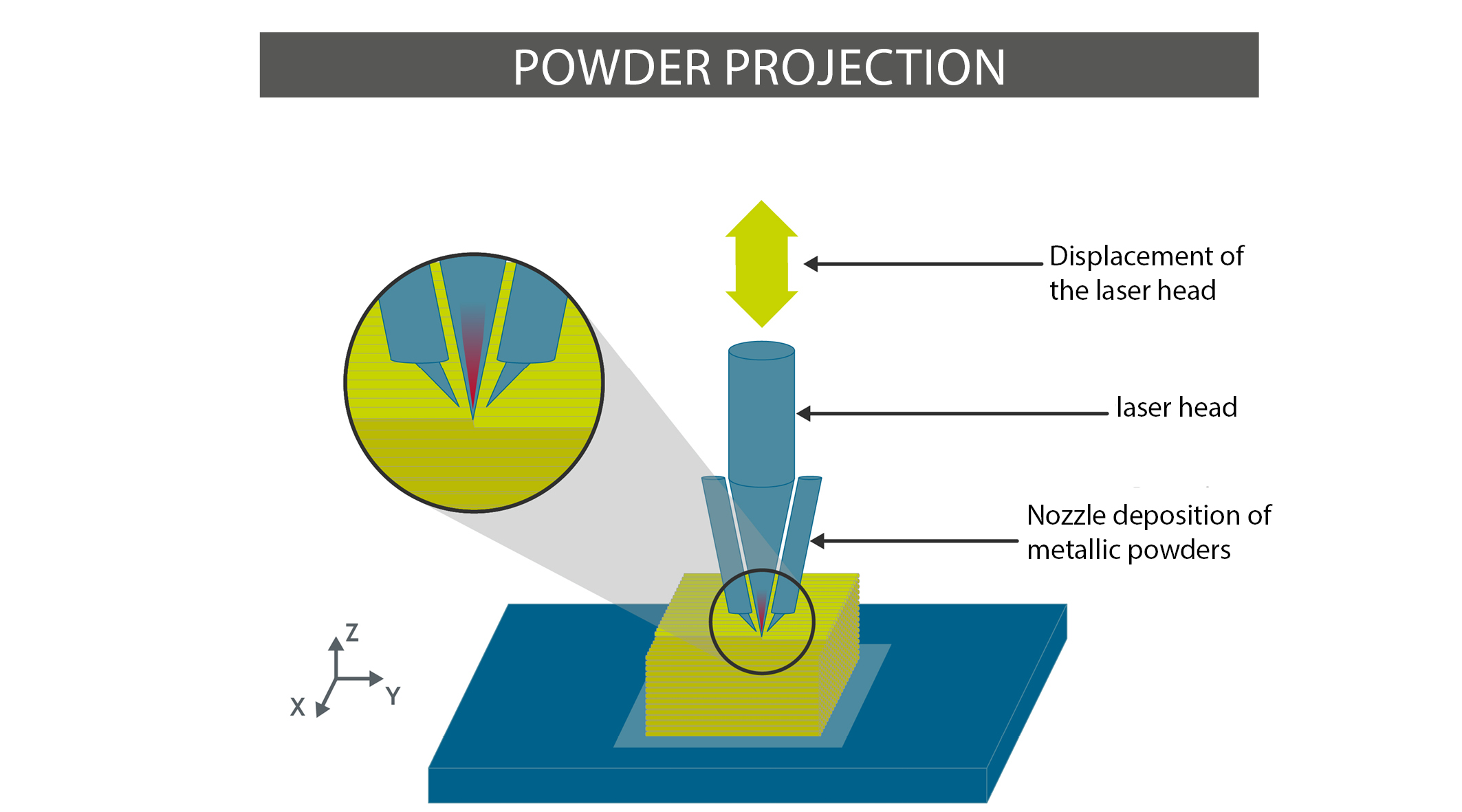
Directed energy deposition supplies feedstock to a melt pool created by an energy source. The illustrated system uses powder and a laser; other DED configurations use wire, an electron beam or an electric arc.
What type of metal additive manufacturing technology is most widely used in the automotive and aeronautics sectors?
For Benjamin Denayer, Senior Business Developer Additive Manufacturing at Sirris, LBM (laser-based manufacturing technology) is the most widely used type in both industries.
Known by various names (in this case, powder bed fusion process), Benjamin Denayer explains that, in addition to LBM, “other technologies, such as WAAM (Wire Arc Additive Manufacturing) are drawing much attention in the aeronautics sector. This technology can, indeed, construct bigger structures; is faster but less accurate. Today, building surfaces are essentially constructed with measurements of 350x350x350mm and not all applications can be printed on such printers. 3D printers’ manufacturers are investing in research and building bigger printers and maybe someday, it will also become cost efficient for bigger parts.”

What are the recommended materials for each type of technology?
Both types of metal additive manufacturing require the use of materials that are relatively diverse.
Metal powder bed fusion
For metal PBF, feedstock is a qualified metallic powder. Polymer powder-bed processes are a different application of the wider process family.
Fusion joins the deposited material to neighbouring regions and the layer below. Bonding and defects depend on process conditions; cohesion must be established through suitable qualification and inspection.
AM based on Directed Energy Deposition
DED can use several alloy families, depending on the equipment and feedstock. A deposited part does not automatically have the properties of a forged or cast equivalent. Material, process settings, thermal history and subsequent treatment all matter.
Note that despite this variety of materials available on the market, each company has its own preferences. Airbus, for instance, mainly uses Titanium and Aluminum for the manufacture of its parts while 3D Systems, in its offering to companies in the automotive and aerospace sectors, offers the possibility to manufacture parts in Titanium, Stainless Steel, Cobalt-Chrome, Aluminum Alloy, Maraging Steel, Nickel and Super Alloy materials.
However, Benjamin Denayer believes that in the current state of the market, the full range of materials that can be used in both business sectors is not fully exploited. “There are still a lot of possibilities on materials. Today, some materials are not yet printable and could be an issue. But again, when you are looking at the aerospace sector, a lot of titanium and aluminum is already used. For aerospace and automotive, there is already a large number of materials available that could work. Maybe if we look into other sectors the limits of materials are more critical but for these two sectors, not really.”
Professionals’ tendency to compare additive manufacturing (AM) materials and materials used in material removal manufacturing methods
Most of the time, in order to better understand the use of additive manufacturing technology in a given sector, engineers tend to compare it with conventional manufacturing methods they know best. Dr. Martin McMahon, Business Development Manager, Additive Manufacturing Solution Centers at Renishaw, draws attention today to this type of comparison with materials:
“Most people say: “how can AM materials be compared to materials used in traditional technologies?” You can make comparisons but you can never make them the same. Engineers are used to designing whilst taking into account the properties of materials for conventional techniques. For many years, engineers have been somewhat suspicious about metals produced by laser powder bed fusion, partly because of the misunderstood use of the words “laser sintering”, which is now falling out of use in favor of powder bed fusion.
Most materials produced by laser powder bed fusion now exhibit mechanical properties close to standard wrought materials and attention is turning to the ability of the AM systems to consistently produce parts at an acceptable quality, backed up by sensor-based process data. Just like casting, which was only adopted in high technology manufacturing once a degree of confidence in the consistency of the process was achieved, AM will follow a similar if accelerated route, backed up by intelligent process monitoring tools and, the great number of research projects that have been carried out to understand these properties to enable people to confidently use AM components. There are still limits but a growing confidence in the data is fostering the adoption of AM materials by big companies today in production.”
These comparisons concern materials and processes assessed by the speakers. They do not demonstrate equivalence for every alloy, loading condition or application.
Before discovering the specificities of each sector of activity, let us determine the similarities and differences that link both automotive and aerospace sectors.
2.Automotive and aeronautics: two closely related and yet very different sectors
For Kay-O Kissling, Sales Manager Aerospace – EMEA at 3D Systems:
“In the automotive sector, it is not only about the supply chain, but also about cost, time-to market, and the complexity which lies in the feasibility of the process compared to traditional ways of manufacturing.
However, for the manufacture of aeronautical parts, lightness and part performance are two main focuses.
Another difference between both sectors is that in the automotive industry, a great deal of the 3D Printing application is prototyping parts for fit, form and function testing.
Lastly, a key difference is documentation. The aeronautic sector has the highest documentation. Everything must be certified, verified and traceable by the aviation authorities. The qualification and the certification by the authorities are the key challenges of this sector.”

2.1. 3D printing in the aerospace sector: «to be lightweight to fly more efficiently»
Aerospace applications can benefit from weight reduction, component consolidation and new geometries. High-temperature capability is a property to qualify for the selected alloy and process, not an automatic consequence of 3D printing.
For Kay-O Kissling, “3D printing contributes to the aerospace sector on 2 major axes:
– When considering printed parts, 3D printing improves the part performance, brings a new design and pushes the limits of light-weighting. It also highlights the customization and consolidation of parts.
– Another major contribution to consider is the “commercial aspect”. Commercial aviation is the most extreme example here given its very long and complex supply chain. What 3D printing offers is the possibility of reducing the complexity of the supply chain (by enabling to gain more transparency in the supply chain) and offering a shorter time to market in regards of the production time. 3D printing also lowers the risks in the supply chain for the commercial aviation sector.”
Delphine Carponcin, Product Development Engineer at Airbus, joins Kay-O Kissling on certain points such as the lightness of the part. If we had to determine whether additive manufacturing (AM) is more advantageous than traditional manufacturing methods (especially those by removal of material), the lightness of the part manufactured using AM would therefore be considered as an advantage.
Kay-O (3D Systems) specifies that if we have good results in terms of part consolidation, “in terms of feasibility, a lighter part does not necessarily mean that it is more performant.
And even yet, 3D printing is a process more expensive than the conventional manufacturing methods for medium to high volumes. So, if you have a small part to bring to mass production, 3D printing will not necessary be the best business model.”
The comparison in terms of «costs» includes another aspect at Airbus:
Delphine Carponcin explains while talking about the experience of Airbus in the sector:
“That there is a gain in mass, because one can manufacture optimized geometries.
As far as manufacturing times are concerned, for the time being we are equivalent to conventional techniques because additive manufacturing also involves a lot of control and verification. The more mature the technology is, the more control time will reduce. In the long run, we might certainly reduce the delivery time of parts.
In terms of cost, the comparison really depends on the type of part. If we compare one by one, another advantage of the ALM (Additive Layer Manufacturing) is left apart: the possibility of creating parts that are not possible with machining. Moreover, there is certainly a cost advantage when it comes to manufacture several parts in one.
However, attention is to be made on the cost analysis which must be done according to families of parts.”
As far as mechanical characteristics of parts are concerned, at Airbus, “Titanium parts have mechanical properties that are equivalent to other metal properties. For aluminum, certain series of alloys can be compared. A 4000-aluminum part obtained by ALM integrates properties that are similar to a conventional aluminum part.
In other words, when we use the same properties and the same alloys as traditional technologies, we will have mechanical properties that are close but aluminum will require the use of a specific alloy to be able to use it in the additive manufacturing.
Lastly, at the very beginning of the design phase, a particular attention should be paid to the “santé matière”: metal parts in ALM are still characterized by a slight porosity, which must be taken into account in the analysis and assessment of an alloy or a part.”
Here, “santé matière” refers to material integrity, including defects and porosity. Acceptance criteria depend on the component and its service requirements.
2.2. 3D printing in the automotive sector: «Good bye conventional methods, hello mass production?»
If the aforementioned benefits of metal 3D printing are the same for the manufacturing of cars, Michael Sattler, Direct Sales Manager, DACH, 3D Systems, confirms that metal 3D printing is also being used in the manufacture of low volume automotive applications including classic car spare parts and racing car parts.
However, the challenge in automobile “lies in designing a part so performant that it covers multiple functions and its complexity therefore requires additive manufacturing to produce it.”
Michael Sattler described a 500 × 500 × 500 mm maximum build envelope in the offering discussed at the time. That was a limit of the equipment in question, not a universal limit for metal AM. He also highlighted integration of software, machines and materials.

Frank Götzke, then responsible for new technologies at Bugatti, also highlighted production time. Comparing printing with forging or die casting requires a consistent scope: tooling, batch size, heat treatment, machining and inspection can all affect the total lead time.
To talk about a specific case at Bugatti, Frank G. explains that they use «this technology for the Chiron prototype cars and also for the current production car.» The company uses materials such as UMS (Ultra Modulus Strength) carbon fiber, high strength titanium alloys, high strength steel alloys, high strength aluminum alloys, and carbon ceramics. However, no limit is observed for the small quantities they need.
Frank Götzke shares with us a particular case of the use of 3D metal printing in the manufacture of one of their parts:
“We developed a little mounting bracket with an integrated water cooling circuit which makes it possible to reduce the temperature of the electric gearbox shifting pressure pump by 40°C. This part was printed out of an aluminum alloy because no bigger tensile strength was needed here. For parts where a higher tensile strength is needed, such as brake calipers or wishbones, the only material suited for 3D printing is titanium which reaches a tensile strength of around 1,250N/mm2.”
The material choice and strength figure in this account concern Bugatti’s application. They do not establish titanium as the only printable high-strength material. Bugatti’s 2018 brake-caliper announcement also describes heat treatment and machining after printing.

The interviews distinguish limited-series applications from high-volume automotive production. Economic suitability must be assessed for the specific part and production route rather than inferred from a blanket limit on serial manufacture.
For Frank Götzke, “Even if experts find that additive manufacturing technologies are 10,000 times faster than today’s technologies and are able to work with high-tensile alloys made from any material needed, there will always be the need for precision machining and finishing through cutting production technologies like for instance turning, milling, grinding and honing.”
3. In a nutshell, what have we retained?
Based on our analysis and the different stakeholders’ contributions in this dossier, the following advantages and focal points can be brought out:
Advantages and focal points in the aeronautics sector:
Potential benefits
- Weight reduction where design and qualification support it
- Consolidation of assemblies
- Geometry and functional integration
- Suitability for selected low-volume components
Points to assess
- Material integrity, traceability and component qualification
- Total lead time including inspection and finishing
- Build envelope and process compatibility
- Cost per acceptable part at the required volume
Advantages and focal points in the automotive sector:
Potential benefits
- Prototyping and functional development
- Integration of features and reduction of assembly
- Selected spare parts and limited-series applications
Points to assess
- Materials and joining needs specific to the design
- Production rate and repeatability
- Finishing and inspection requirements
- Comparison with conventional production at the intended volume
Conclusion
In the end, the experts remain positive on the integration of 3D metal printing in the production processes of the automotive and aerospace sectors. However, each of these sectors has its own set of points that must be taken into consideration, in terms of certification, materials used or even production time.
Metal AM complements conventional processes. Its use in production depends on the design, material, qualification, volume and complete cost of the manufacturing route. The relevant question is which parts and conditions justify that route.
THE 3D ADEPT WEEKLY NEWSLETTER
The industry moves fast. Stay ahead.
Every week, the latest additive manufacturing news, in-depth features and real-world applications, straight to your inbox. Plus, be the first to know when a new issue of 3D ADEPT Mag is out.
Free · One email a week · Unsubscribe anytime
Clicking loads our email provider’s sign-up form, including its analytics and Google’s anti-bot protection. You’re only subscribed if you complete the sign-up. Read our privacy policy.