

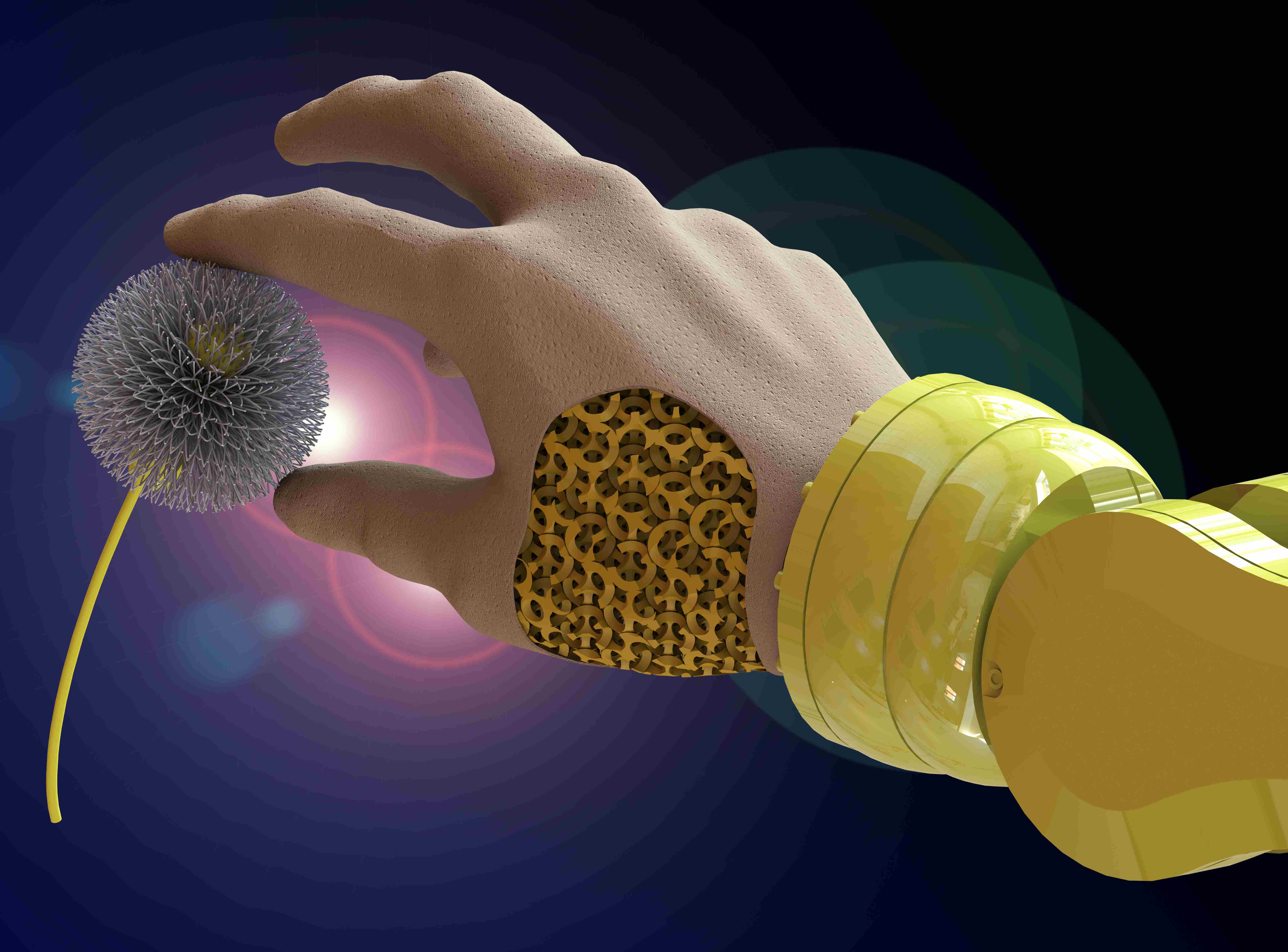
Soft robotics show a great potential when they can safely interact with humans and other delicate objects. They enable the production of soft programmable mechanisms that are used to power this new generation of robots.
In that context, researchers at TU Delft have developed programmable actuators that, similar to the human hand, combine soft and hard materials to perform complex movements.
“What you really want, is something resembling the features of the human hand including soft touch, quick yet accurate movements, and power. And that’s what our soft 3D-printed programmable materials strive to achieve”, said Shahram Janbaz, one of the researchers that authored the report.
Flexible mechanical metamaterials working on the basis of mechanical instability, offer unprecedented functionalities programmed into their architected fabric that make them potentially very promising as soft mechanisms. ‘However, the tunability of the mechanical metamaterials proposed so far have been very limited’, says Shahram Janbaz.
‘We now present some new designs of ultra-programmable mechanical metamaterials where not only the actuation force and amplitude but also the actuation mode could be selected and tuned within a very wide range. We also demonstrate some examples of how these soft actuators could be used in robotics, for instance as a force switch, kinematic controllers, and a pick-and-place end-effector’, says Janbaz.
Where does 3D Printing come into play?
‘So, we present multi-material buckling-driven metamaterials with high levels of programmability’, says Janbaz. ‘We combined rational design approaches based on predictive computational models with advanced multi-material additive manufacturing techniques to 3D print cellular materials with arbitrary distributions of soft and hard materials in the central and corner parts of their unit cells. Using the geometry and spatial distribution of material properties as the main design parameters, we developed soft mechanical metamaterials behaving as mechanisms whose actuation force and actuation amplitude could be adjusted’, concluded the author.
The whole study can be read in the July Issue of Materials Horizons. You can now post free of charge job opportunities in the AM Industry on 3D ADEPT Media. For further information about 3D Printing, follow us on our social networks and subscribe to our newsletter : Facebook, Twitter, LinkedIn & Instagram !
Would you like to be featured in the next issue of our digital magazine? Send us an email at contact@3dadept.com
THE 3D ADEPT WEEKLY NEWSLETTER
The industry moves fast. Stay ahead.
Every week, the latest additive manufacturing news, in-depth features and real-world applications, straight to your inbox. Plus, be the first to know when a new issue of 3D ADEPT Mag is out.
Free · One email a week · Unsubscribe anytime
Clicking loads our email provider’s sign-up form, including its analytics and Google’s anti-bot protection. You’re only subscribed if you complete the sign-up. Read our privacy policy.