


Archive — March 2019 guest article by Jeanett Tschiersky and Dr. Sergej Stoetzer of Conrad Business Supplies. The contribution and author credits are preserved. Editorial technical clarifications distinguish printing processes, design software and classroom precautions; product examples refer to the original period.
This article has been written by Jeanett Tschiersky, Director CTC Strategic Marketing and Dr. Sergej Stoetzer, Senior Expert CTC Strategic Marketing & Trainings at Conrad Business Supplies
Hardly any technology has developed as quickly as 3D printing within just a few years. In a very short timeframe, a device for professional prototyping became a suitable tool for hobbyists, with which today even large components and complex components are produced – right through to small-batch production using additive technology.
Printing techniques in the 3D world

There are many ways to create 3D objects. One approach developed in the late 1980s is the layered deposition of molten material, which solidifies and thus “prints” layer by layer into a three-dimensional object. The process is referred to as Fused Deposition Modelling (FDM) or Fused Filament Fabrication (FFF). These processes belong to “additive manufacturing” because material is added layer by layer – unlike conventional metal-cutting where an object takes on its shape by removing material from a piece of metal.
Other printing methods include selective laser sintering (SLS) and stereolithography (SLA). In polymer SLS, a laser selectively fuses powder in a heated bed. The surrounding powder supports the part, and the build must cool in a controlled manner before unpacking. Metal laser powder bed fusion is a related but distinct process, often called SLM or DMLS. Layer thickness, detail and material compatibility depend on the equipment and process.
Stereolithography is one of the 3D printing processes involving liquids. It was one of the earliest commercial 3D printing technologies. In this process, the object emerges from a bath of liquid photopolymer resin, which is cured at the relevant points by a laser. The procedure is technically quite complicated, but nevertheless very well developed. Objects can be produced very precisely, but only certain plastics are suitable for SLA printing.
Another method is PolyJet material jetting. With different print heads different materials can be processed and combined accordingly.
Print heads deposit photopolymer droplets, cured by UV light, alongside removable support material where needed. Some systems combine materials or colors to obtain different properties. Those capabilities depend on the machine and material configuration, not simply the number of print heads.
For an introductory overview, processes can be grouped by feedstock form. This is a simplified grouping, not the standardized classification of additive manufacturing technologies:
- Powder feedstocks, including polymer SLS and metal powder bed fusion.
- Thermoplastic filament, as used in FDM/FFF material extrusion.
- Liquid photopolymers, cured in a vat for SLA or deposited as droplets for PolyJet material jetting.
How does a 3D printer work?
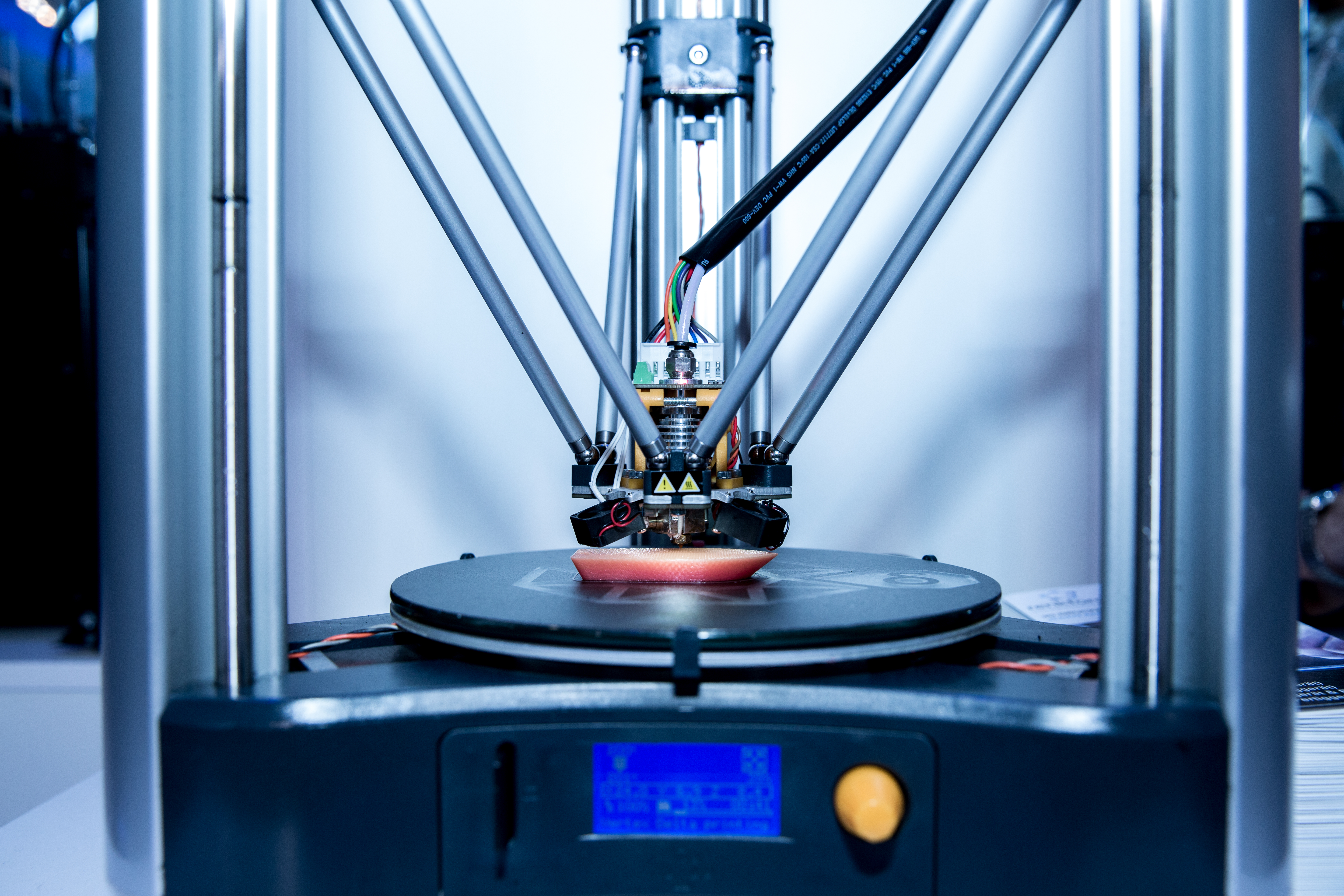
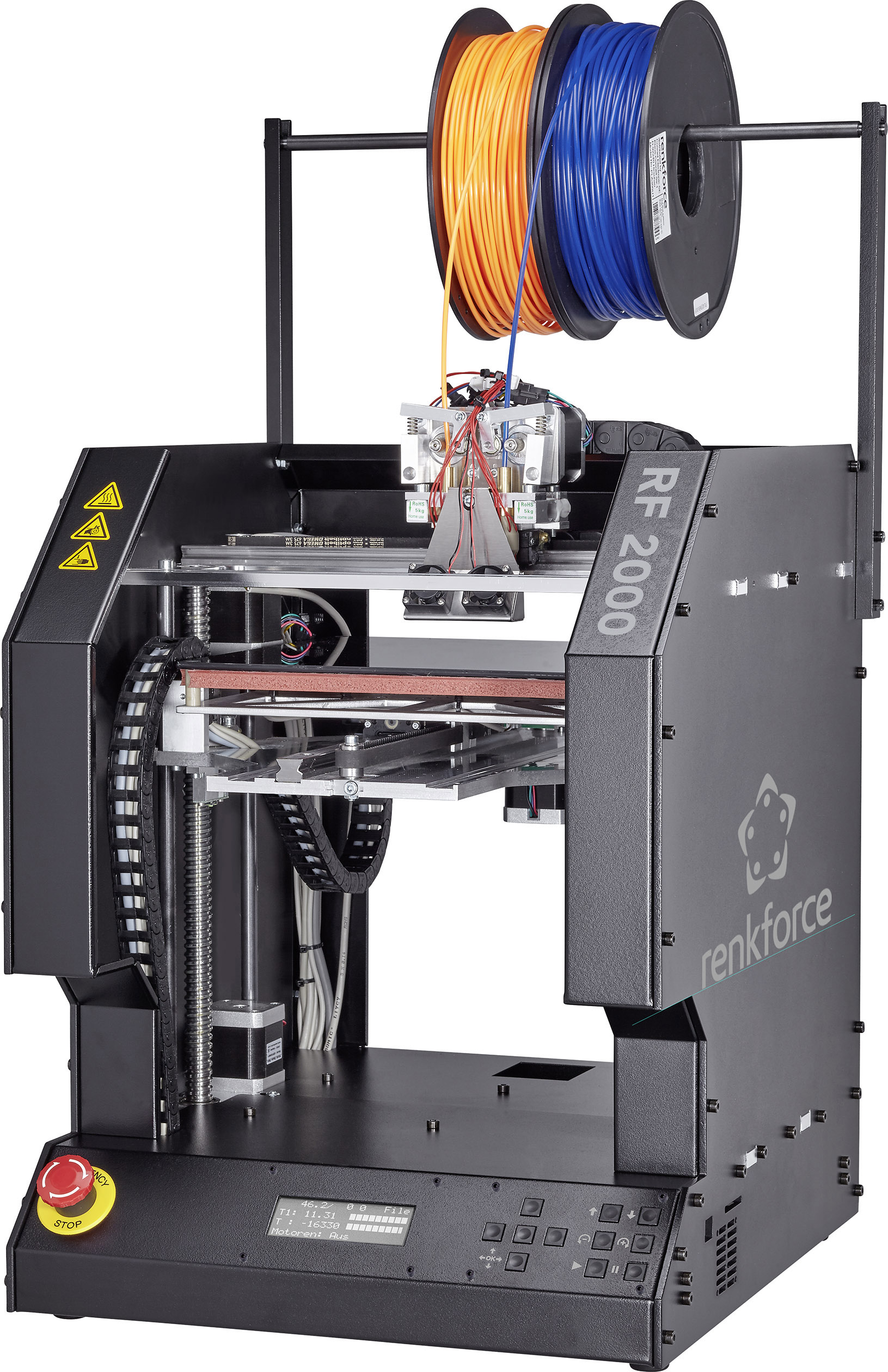
With the distinctly different 3D printing processes, also different are the technical requirements for the respective printers. Therefore, the question of the function of a 3D printer can’t be solved separately from the printing process. In an FDM process, a plastic filament is melted in the print head and extruded through a nozzle. The molten plastic is applied to a platform and cooled there. This is how the component is built up in layers. Depending on the component, this method requires a support structure that gives it stability during the printing process for structures with flat angles (overhangs, bridges). Supports can be made from the same material or, on suitable multi-material systems, a separate support material. They are removed after printing.

In metal laser powder bed fusion, a laser melts selected regions of a powder layer. The platform then lowers and another layer is spread. Supports may anchor the part and conduct heat. Polymer SLS also uses a laser and powder bed, but the surrounding powder generally supports the part without separate printed supports. Powder removal and appropriate post-processing follow the build.
When printing with liquid materials, there are, as mentioned above, different printing principles. The polyjet process uses print heads similar to those of an inkjet printer. The material of photopolymers is applied drop by drop and cured directly by UV light. You can use different materials as well as different colours at the same time. An easily removable support structure is also necessary. In stereolithography plastic is also cured by UV light. However, this requires a UV laser. This forms the structure of the component directly in a bath of photopolymer, which hardens in the focus of the laser.
From idea to 3D component
Just as conventional 2D printers require a template (a text or image in the form of a file) to make a printout, 3D printing also requires this. However, the user has to create a three-dimensional model for this. For beginners, there are numerous ready-made 3D models that can be downloaded for free on the Internet. In educational institutions or in research, however, it will be important to create the models according to your own ideas.
CAD software creates the geometry. A separate preparation step, often performed in a slicer, divides that geometry into layers and produces instructions compatible with the printer. Manufacturers and independent developers provide such tools. In addition, independent manufacturers offer appropriate CAD software with a wide variety of equipment and for a wide range of requirements – sometimes free of charge. The possibilities range from relatively simple forms to complex constructions or even entire sculptures. Each user can select the software according to their requirements.
Of course, there is also support on the Internet or from the manufacturers. Particularly interesting is the ability to transfer data from a 3D scanner to a 3D printer. In addition to the CAD programs for template creation, there is also software to check or repair CAD templates.
An example of freely available software for creating 3D printed models is the Tinkercad online app. This is great for schools because it does not require any CAD experience or software installed on the computer. From simple shapes, the desired components can be built. These can also be imported. On-screen appearance is only a visualization; the physical part depends on the printing process and material selected. The shapes can be moved, rotated and adjusted freely in space. With tools such as the ruler, dimensions can be entered exactly. Furthermore, different shapes can be combined to create models with the desired depth of detail.
Which printer for which applications?
Similar to the software, this applies to the choice of printer. Users first have to clearly define which goal they want to achieve. The differences from lower-end to high-end expensive 3D printers are not fixed. Price alone does not establish quality, resolution or ease of use: those properties need to be assessed against the intended parts and workflow. The equipment, such as the number of printing or extruder heads varies. Of course, the processing also plays a role when it comes to cost, as well as the technology used.
3D printers in education facilities

FDM printers are often considered for beginners and education because of their relatively accessible equipment and filament costs. Selection must also consider training, supervision, maintenance and exposure control. Filament printing can emit particles and volatile substances and involves hot surfaces; ventilation or suitable source capture may be needed. Powder systems and photopolymer resins bring different handling risks, requiring controls suited to the material and equipment.
To introduce beginners to the possibilities of 3D printing, FDM printers with single extruders can be a practical starting point. The flexibility in the production of components depends on the design tools as well as the printer, material and process settings. Here, the user can choose freely, the offer ranges from simple online applications to highly specialised CAD programs.
THE 3D ADEPT WEEKLY NEWSLETTER
The industry moves fast. Stay ahead.
Every week, the latest additive manufacturing news, in-depth features and real-world applications, straight to your inbox. Plus, be the first to know when a new issue of 3D ADEPT Mag is out.
Free · One email a week · Unsubscribe anytime
Clicking loads our email provider’s sign-up form, including its analytics and Google’s anti-bot protection. You’re only subscribed if you complete the sign-up. Read our privacy policy.