

Texas Instruments is a semiconductor and design manufacturing company that uses the latest technology in order to develop analog ICs and embedded processors. According to the company, DLP® Pico™ controllers offer optimised light control capabilities in smaller form factors for mass-market 3D scanners and 3D printers.
DLP Technology integrates controllers that deliver the micron-to-sub-millimeter resolution typically found in high-performance, industrial-grade applications in a smaller form factor for desktop 3D printers and portable 3D scanners.
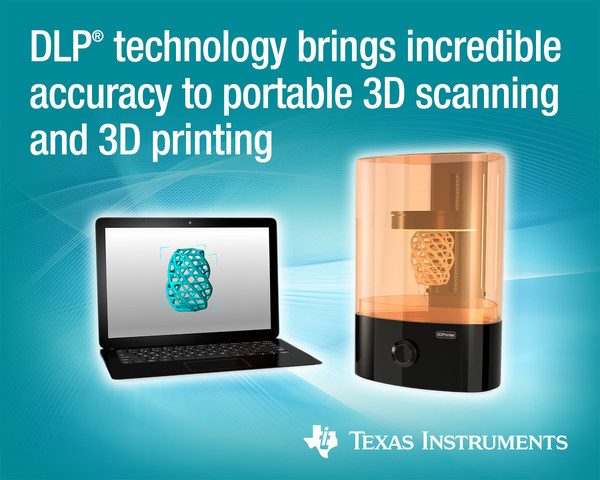
“Developers can pair the new DLPC3470, DLPC3478 or DLPC3479 controller with one of four existing DLP Pico digital micromirror devices (DMDs) to design a variety of battery-powered and handheld designs. The high resolution and fast switching speed of the DMDs and new controllers enable 3D printing speeds five times faster than existing technologies. With precision pattern control in a smaller form factor, developers can capture the fine details of an object with micron-level accuracy, which benefits applications like dental scanning, 3D modeling and 3D vision for robotics.”
In addition to optimized accuracy, speed and wavelength, DLPC347x controllers shorten time to market. Furthermore, they often enable professionals to develop new applications. Indeed, it is now possible for developers and manufacturers to create smaller 3D printing and 3D scanning designs with higher precision. Lastly, in terms of size versality, “by pairing one of the new controllers with a DLP2010 (480p), DLP2010NIR (480p), DLP3010 (720p) or DLP4710 (1080p) DMD, which range in diagonal size from 0.2 to 0.47 inches, developers can create customized solutions by combining the controllers and DMDs that best fit their applications. This capability allows for easy integration into a variety of low-power 3D scanners and 3D printers.”
For further information about 3D Printing, follow us on our social networks and subscribe to our newsletter
Would you like to subscribe to 3D Adept Mag? Would you like to be featured in the next issue of our digital magazine? Send us an email at contact@3dadept.com
//pagead2.googlesyndication.com/pagead/js/adsbygoogle.js
(adsbygoogle = window.adsbygoogle || []).push({});
THE 3D ADEPT WEEKLY NEWSLETTER
The industry moves fast. Stay ahead.
Every week, the latest additive manufacturing news, in-depth features and real-world applications, straight to your inbox. Plus, be the first to know when a new issue of 3D ADEPT Mag is out.
Free · One email a week · Unsubscribe anytime
Clicking loads our email provider’s sign-up form, including its analytics and Google’s anti-bot protection. You’re only subscribed if you complete the sign-up. Read our privacy policy.