

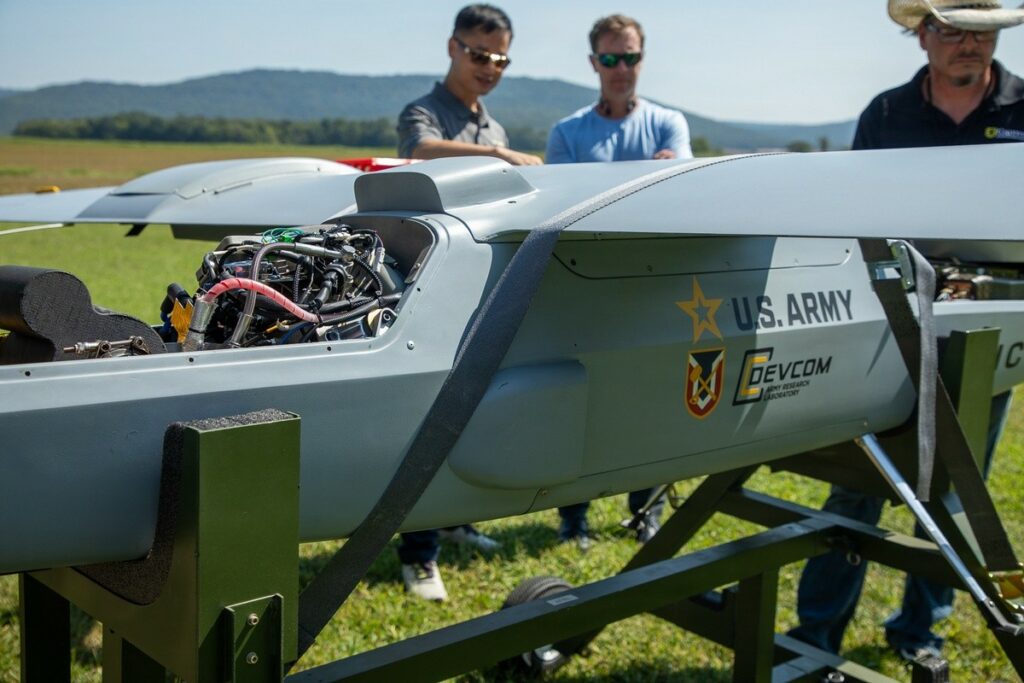
Small drones have long faced a fuel mismatch: most run on gasoline, while militaries rely on kerosene-based fuels. Researchers at the U.S. Army Combat Capabilities Development Command Army Research Laboratory addressed this challenge with the flight demonstration of a 3D printed heavy-fuel engine.
The system is a heavy-fuel rotary-engine series hybrid developed under ARL’s Versatile Tactical Power and Propulsion essential research program. The engine is paired with a novel 400-volt motor-generator system and is designed to support vertical takeoff and landing operations in contested environments.
To test it in flight, ARL worked with industry partners, including Griffon Aerospace, to build an aircraft around the propulsion system. The result is VICTOR (Versatile Intelligence Controlled Tactical Operational Reconnaissance and Attack), a Group 3 midsized unmanned aircraft system, which was flown near Huntsville, Alabama.
Making heavy fuel work in a rotary engine
Rotary engines are compact and power-dense, which makes them attractive for mid-sized drones. Heavy fuel, however, is harder to atomize and vaporize than gasoline, and rotary architectures are prone to leakage.
ARL researchers used advanced computational fluid dynamics modeling and a clean-sheet design approach to improve fuel atomization and vaporization while minimizing compressed-air and fuel-vapor leaks.
“The use of advanced manufacturing, including 3D metal printing, allowed us to rapidly redesign engine components based on lessons learned through experimentation,” said Dr. Chol-Bum “Mike” Kweon, DEVCOM ARL program manager. “It enabled us to design an air-cooled engine that reduces propulsion-system size and eliminates the need for liquid coolant.”
Just like we saw with Beehive Industries’ 3D printed jet engine for unmanned defense vehicles, metal 3D printing served here first as a development tool. It shortened the loop between test, lesson learned and redesigned part, and it made an air-cooled architecture possible. For a drone, removing a liquid cooling circuit means less weight and volume to carry, and endurance and payload depend on exactly that.
What comes next
Beyond the flight itself, the program involved more than 30 universities, more than 13 federal laboratories and more than 20 industry partners, and has produced tens of patents and patent applications. According to Kweon, findings have already been “transitioned to industry partners for maturation and integration into capabilities that could enable mid-sized drones to operate beyond line of sight.”
Lessons from the program will feed into PULSAR (Persistent Unmanned Aircraft System for Logistics, Strike, Autonomy, and Reconnaissance), a concept that uses a swarm of VICTOR drones for multi-mission operations. Both VICTOR and PULSAR will be made available to military partners for further experimentation, while industry partners keep refining VICTOR for other applications.
THE 3D ADEPT WEEKLY NEWSLETTER Every week, the latest additive manufacturing news, in-depth features and real-world applications, straight to your inbox. Plus, be the first to know when a new issue of 3D ADEPT Mag is out. Free · One email a week · Unsubscribe anytime Clicking loads our email provider’s sign-up form, including its analytics and Google’s anti-bot protection. You’re only subscribed if you complete the sign-up. Read our privacy policy.The industry moves fast. Stay ahead.