

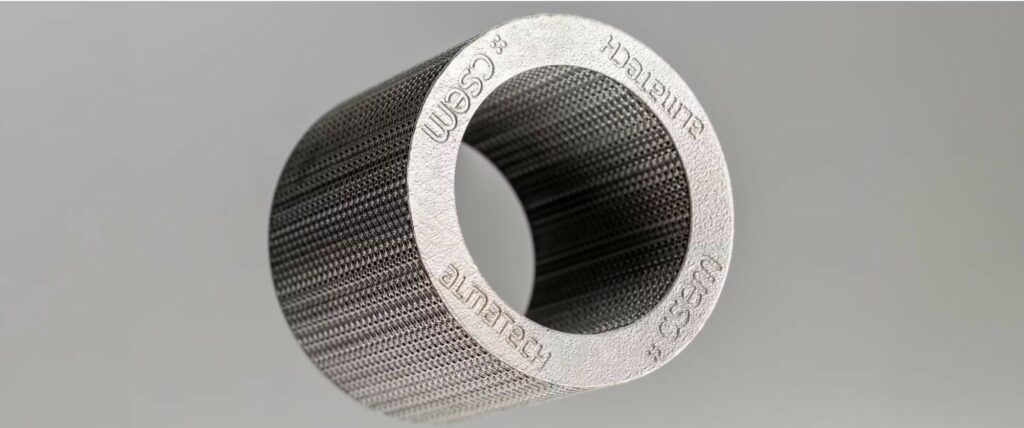
Swiss research center CSEM and space engineering company Almatech have demonstrated a reusable shock absorber for lunar and planetary landers, 3D printed in nickel-titanium (NiTi) shape memory alloy. Developed under the ESA-supported RESHAPE project, the demonstrator absorbed impacts predictably over multiple landing cycles, according to CSEM.
We have observed that most spacecraft built to land only do so a single time, whether on a planet, moon, or asteroid. The Apollo Lunar Module, for example, used crushable aluminum structures in its landing legs to absorb the impact of landing. Once they were compressed, they could not be used again.
To ensure reliability of such spacecraft, RESHAPE, led by CSEM (Swiss Center for Electronics and Microtechnology) with Almatech as industrial partner and support from the European Space Agency (ESA), set out to test a shock absorber that recovers after each landing.
How does a 3D printed shape memory alloy absorb a landing?
The demonstrator combines NiTi, an alloy known for recovering its original shape after large deformations, with a lattice architecture that lets engineers tailor how a structure deforms and dissipates energy.
CSEM produced the lattices by laser powder bed fusion (LPBF). Its work covered the selection of lattice geometries, the development of printing parameters for fine NiTi lattices, and quasi-static, high-speed impact and reusability tests.
“RESHAPE demonstrates that shape memory alloy lattice structures can deliver predictable and reusable impact absorption over multiple landing cycles,” said Vaclav Pejchal, Material & Technology Expert at CSEM. He adds that combining the two technologies lets the team “rethink components that have remained unchanged for decades.”
The test data then went to Almatech, which develops landing leg systems for European launcher companies. Almatech used it to scale lab-level material behavior up to a full-scale shock absorber design for its landing-leg system.
Dr. Fabrice Rottmeier, Chief Technology Officer at Almatech, describes RESHAPE as “another great illustration” of a partnership that combines “CSEM’s deep technological expertise with Almatech’s space engineering and application know-how.”
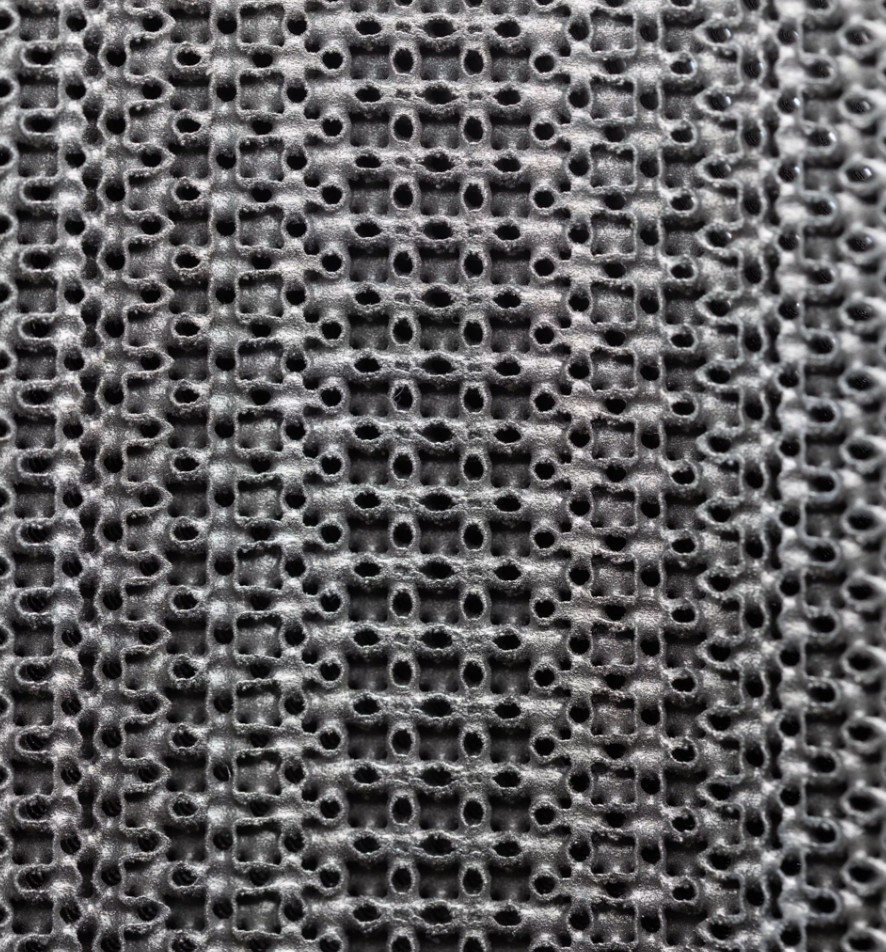
At this stage, RESHAPE is a demonstrator
The partners have not disclosed the number of landing cycles, impact energies, mass or technology readiness level that could help consider a potential flight.
This means repeatability will matter just as much. NiTi’s functional properties are notoriously sensitive to composition and thermal history, which explains CSEM’s emphasis on process control: If a shock absorber performs differently every time it is made, it cannot guarantee a reliable landing.
THE 3D ADEPT WEEKLY NEWSLETTER
The industry moves fast. Stay ahead.
Every week, the latest additive manufacturing news, in-depth features and real-world applications, straight to your inbox. Plus, be the first to know when a new issue of 3D ADEPT Mag is out.
Free · One email a week · Unsubscribe anytime
Clicking loads our email provider’s sign-up form, including its analytics and Google’s anti-bot protection. You’re only subscribed if you complete the sign-up. Read our privacy policy.