

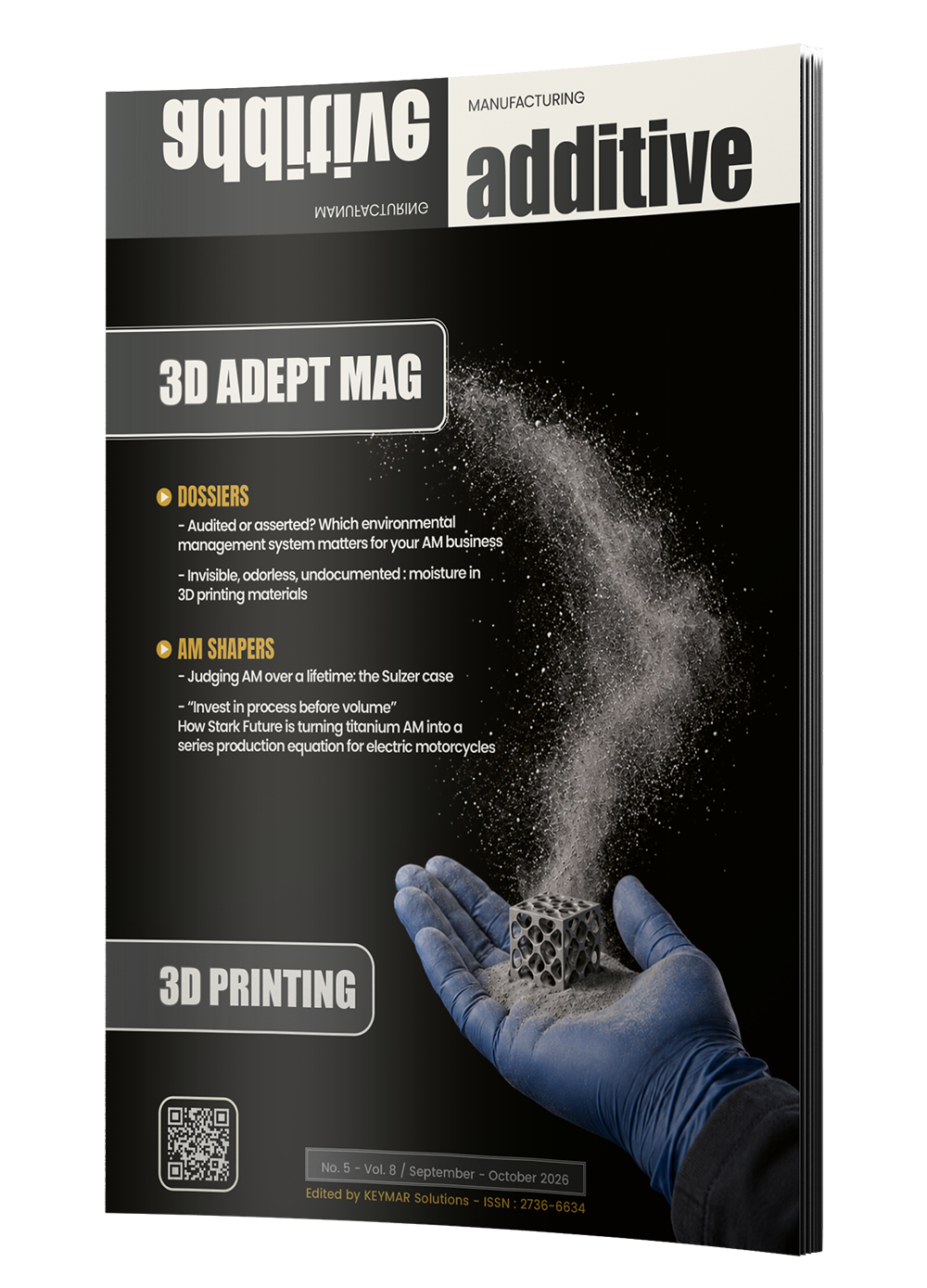
3D ADEPT MAG · N° 52
September / October 2026
English edition · Digital magazine
Features, interviews and applications: explore this issue’s stories and continue reading in the magazine.
Prove it
Many in the aerospace industry believed that landing an orbital-class booster upright was impossible and wouldn’t make economic sense.
After several major failures, SpaceX landed its first Falcon 9 booster in December 2015. The company proved both the physics and the business case and forced legacy aerospace giants to rewrite their long-term strategies.
This is one example among thousands where companies had to prove a concept that everyone else thought was impossible, foolish, or bound to fail.
Sometimes, I am tempted to believe that sustainability in our industry has never really been put to such a test. Because AM does not deliver the production volumes of conventional manufacturing, the pressure to prove its environmental case is not the same.
If you read these lines and think I am just another person who will talk about a topic that is not a priority for your business right now, let me share another angle: every 3D printed part is produced with the hope that it will perform as intended, and that choosing additive manufacturing was truly the right choice.
With that in mind, we asked ourselves: “what else does AM need to prove?
Our opening dossier reveals that the decision to pursue environmental certification is increasingly driven by customers’ supplier questionnaires. Our investigation into recycled metal powders highlights different models of traceability, qualification and ISO-based environmental data while our in-depth feature on moisture examines the importance of knowing what happens to a powder between its production and its use.
The same attention to the complete process runs through our production features from Materialise and Solukon to Incus.
While these insights show how much industrial performance depends on the connections between individual steps, the stories of Stark Future and Sulzer confirm there is still room for optimism. In the end, if the operational case is a success, there is a great chance that the sustainability claim naturally follows.
Exclusive features
Dossier | Audited or asserted? Which environmental management system matters for your AM business
ISO 14001 is becoming the entry ticket to supplier shortlists in regulated supply chains. But what does the certificate prove, which other frameworks deserve attention, and where do AM companies stumble when the auditor arrives? Certification experts from two independent bodies, TÜV UK and TÜV SÜD, and Midlands 3D, a UK print bureau certified this summer walk us through it.
AM Shapers by Formnext
“Invest in process before volume”
How Stark Future is turning titanium AM into a series production equation for electric motorcycles
In the additive manufacturing (AM) lab of electric motorcycle maker Stark Future sits a rubber hammer. A few taps, and the tool helps to remove 106 titanium footpegs from the build plate in less than three minutes. This example from David Díaz Mauricio, Head of Additive Manufacturing, reveals how Stark Future is already making a strong case for titanium AM, but can a titanium part be printed a thousand times, identically, at a cost that makes sense on a production motorcycle?
Dossier: Invisible, odorless, undocumented: moisture in 3D printing materials
Moisture is invisible, it has no odor, and on most production sites it is undocumented. It has no universal threshold, and for many operators, the moment of discovery is the moment they are looking at defects in a finished part. The reason why it is so easy to overlook is that it is the result of how the material has been treated since it was made. What exactly does moisture do to 3D printing materials and what is changing in how it is controlled?
Materials
Can you trust 3D printing eco-friendly metallic powders?
This dossier deliberately leaves polymers aside. Most recycled polymers in industrial use today serve applications with no stringent requirements, mainly consumer goods, furniture and design objects. There is less chance of getting it wrong there. Metal 3D-printed parts, on the other hand, come with a lot of pressure especially when they are manufactured for demanding industries. The goal of this article is to help AM users across vertical industries understand if it pays off to invest in 3D printing recycled metallic powders. With contributions from f3nice and Outokumpu.
AM Shapers | Judging AM over a lifetime: the Sulzer case
Almost ten years later, Dr. Yogi Pardhi, Global Lead – AM at Sulzer, legitimately describes Sulzer as an advanced and mature user of the technology, with established internal standards and protocols. Unlike many AM users that leverage the technology within one specific business unit or product line, AM at Sulzer is now “a cross-functional and cross-product line capability.”
FOCUS | Materialise
Lost in translation | How Materialise’s CO-AM helps integrate AM into the factory's software systems
When we look beyond 3D printers, we realize how large the AM software landscape is, and why its categories do not always fit together. All of this makes the workflows surrounding them increasingly complex, and AM production harder to scale. Materialise is positioning itself in a very well-known debate our industry has been having for several years: open versus closed systems.
FOCUS | Solukon
The missing line on the pre-processing checklist | How automated depowdering can influence pre-processing decisions
We have spent years arguing that post-processing, and depowdering in particular, increases the overall cost of a 3D printed part because they rely on slow, manual equipment. The industry has taken a great step forward in reducing that cost driver through automated depowdering, but imagine if we could do even more. What if that cost driver could also be handled at the pre-processing stage, starting with a single question: can this part’s geometry be completely depowdered at all?
FOCUS | Incus GmbH
Mass production, one patient at a time | What makes the Hammer Pro25 a production candidate for medical 3D printed brackets?
Around 6.66 million patients are in active treatment with members of the American Association of Orthodontists in the US and Canada alone (AAO, 2025). While it’s hard to give an accurate number in Europe, (the federal association of statutory health insurance dentists) reported 8.54 million orthodontic billing cases in Germany for 2024. Many of these patients are treated with fixed appliances, and the metal brackets bonded to their teeth are typically produced by metal injection molding (MIM). As patients increasingly need individualized treatment, it becomes hard to produce brackets at the economics of a mold. Incus GmbH aims to fill this gap with its Hammer Pro25, a 3D printer powered by lithography-based metal manufacturing (LMM).
Opinion piece
Is your AM solution green, sustainable, climate or eco-friendly?
Kety is putting the AM industry’s favorite words to the test. In this opinion piece, our Managing Editor reacts to the new EU rules against greenwashing, which came into application on September 27. She starts with an uncomfortable look at our own pages: how often have “green,” “eco-friendly,” “climate” and “sustainable” appeared on 3dadept.com, and what were they really describing? The answer is revealing. So are the few AM companies already backing their claims with evidence.
3D ADEPT MAG
Your next read
September / October 2026
Download the magazine
Complete the fields below to access this issue.