

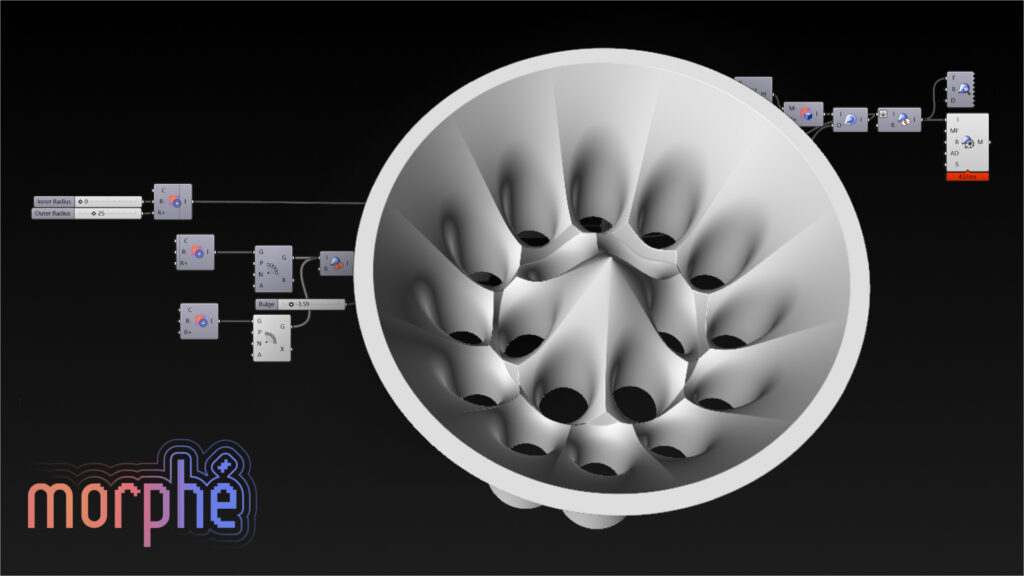
Ahead of the launch of its new Grasshopper plugin, the UK consultancy argues that the hardest part of designing for 3D printing is creating it and being able to change it.
For those who are not tech-savvy, writing and editing a Word file is easy. Once this Word file is saved as a PDF, it becomes a bit tricky to edit it again. To bring a small change to the document, they will have to go back to the Word file, make the edit, export it again and redo the final touches.
That, in a nutshell, is the problem Metamorphic AM wants to solve with Morphé.
Founded by Laurence Coles and Manolis Papastavrou, Metamorphic is a UK-based consultancy specializing in Design for Additive Manufacturing (DfAM): designing parts to make the most of 3D printing. Readers may know it from its Rapid Geometry Review, an expert check of 3D printed designs before they go into production, or from its participation in Nexus, a £1.9M Innovate UK project on 3D printing materials for bioprocessing.
How does Grasshopper work?
Grasshopper is the visual programming tool that runs inside 3D modelling software Rhino. Instead of drawing every line, designers connect rules and data, and the shape follows.
Several examples of how the tool can be used have already been shared across these pages: Designer Simon Pavy used it to shape a 3D printed terracotta cooler whose geometry would have been impossible to draw in traditional CAD. Nathan Smith fed the shape of a foot into a Grasshopper algorithm to create a parametric 3D printed sneaker. Dimensional Innovations generated dozens of possible river paths for MEANDER, while WASP drew on its Grasshopper know-how to build a parametric app for clay 3D printing.
The principle is the same with Morphé: rules generate form. The difference lies in what comes next. In the stories mentioned above, Grasshopper produced a shape that was then printed, mostly in design, art and consumer products.
Metamorphic targets engineering parts such as manifolds where twenty pipes merge smoothly or lattices made of thousands of tiny beams. With such parts, generating the shape is only half the job. Turning it into a clean, solid, printable part often requires exporting it to other specialist software, and that is where the recipe gets left behind.
What does Morphé do?
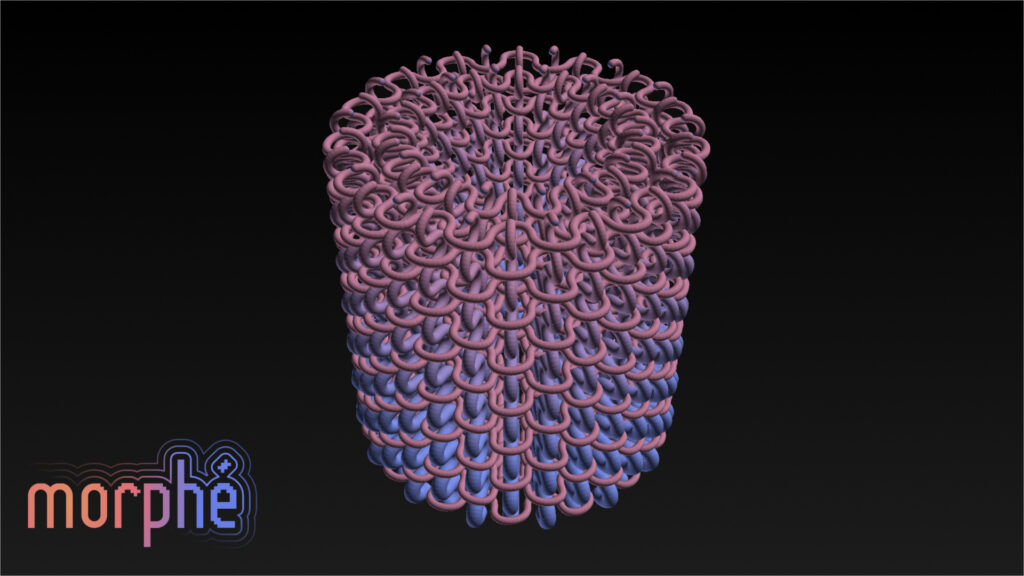
Morphé brings these “finishing” tools directly into Grasshopper. The first is implicit modeling: instead of stitching a shape together from thousands of small surface patches, like sewing a football, you describe it with a formula, like saying “a ball is everything within 5 cm of this point”. The second is voxel processing: voxels are 3D pixels, a bit like building with tiny Lego bricks that can be smoothed, repaired or reshaped. The third is vector fields, which let data such as stress or temperature guide the shape.
Because everything stays in one place, the shape remains connected to the rules that created it. If you change any requirement, the part updates.
“A library gives engineers answers, whereas a genuinely computational environment should give them the means to formulate their own,” the co-founders write.
Morphé is not meant to replace conventional CAD, which remains essential for assemblies, drawings and everyday mechanical design. “The goal should not be complexity for its own sake, it should be geometry that earns its complexity through function,” they add.
Born from Metamorphic’s own projects in quantum technologies and bioprocessing, Morphé will be unveiled very shortly.
THE 3D ADEPT WEEKLY NEWSLETTER
The industry moves fast. Stay ahead.
Every week, the latest additive manufacturing news, in-depth features and real-world applications, straight to your inbox. Plus, be the first to know when a new issue of 3D ADEPT Mag is out.
Free · One email a week · Unsubscribe anytime
Clicking loads our email provider’s sign-up form, including its analytics and Google’s anti-bot protection. You’re only subscribed if you complete the sign-up. Read our privacy policy.