

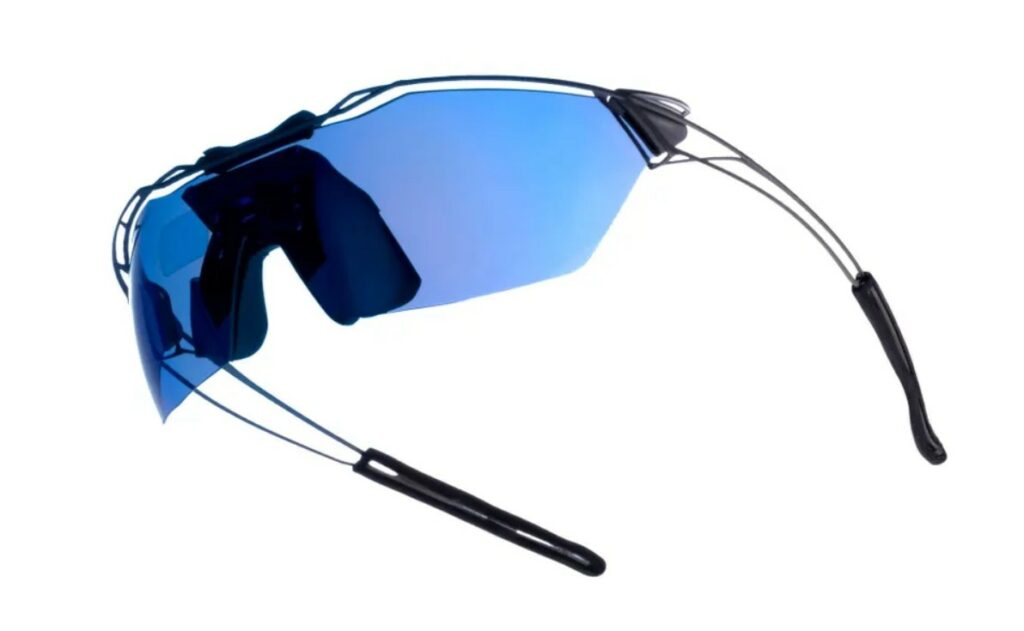
Grenoble-based ENGO has launched Engo Titanium, a pair of augmented reality (AR) glasses for runners and cyclists. Their 3D printed titanium structure brings the weight down to 28.9 grams.
Every gram counts in sports eyewear. Adding a display, battery and sensors makes keeping connected glasses lightweight a design challenge. ENGO tackled that limit with Engo Titanium.
Titanium arms and battery life
Aeronautical design inspired the arms that hold the glasses (also called temples). ENGO manufactured them using metal 3D printing and titanium. The material helps the team save weight. Omitting features such as a camera and stereo speakers also reduces weight.
Instead, the company invested in battery life. ENGO reports more than 24 hours of continuous use per charge.
“With Engo Titanium we redefine what it means to wear performance glasses,” says Éric Marcellin-Dibon, co-founder of ENGO Eyewear. “Our design is so light and seamless that athletes forget they’re even there while still delivering the most relevant data, anticipating their needs, and keeping them fully focused.”
Performance data without looking away
The glasses use ENGO’s light AR technology. A color OLED head-up display shows live performance data such as heart rate, pace and cadence. Users can also customize more than 40 metrics through the companion app. Advanced widgets let athletes follow structured workouts like interval training. They can then adjust their pace in real time without looking away from the road.
“The design aims to deliver the right data without breaking the athlete’s concentration,” Marcellin-Dibon adds. “For an endurance athlete or road cyclist, we believe that means the right information in your field of view, exceptional comfort and enough battery life to forget about the technology altogether.”
At launch, Presse Agence reported on 6 October 2026 prices of €599, or €649 with photochromic lenses for Engo Titanium. It is produced in a numbered limited run of 500 units.
For context, metal 3D printed eyewear frames have been on the market for more than a decade. Luxury and custom-fit titanium frames are among the most mature consumer uses of additive manufacturing. That said, ENGO prints load-bearing titanium parts for a connected sports device. Weight directly determines how much electronics fits. This makes its glasses one of the few commercial examples of AM working as an enabler in smart eyewear.
THE 3D ADEPT WEEKLY NEWSLETTER
The industry moves fast. Stay ahead.
Every week, the latest additive manufacturing news, in-depth features and real-world applications, straight to your inbox. Plus, be the first to know when a new issue of 3D ADEPT Mag is out.
Free · One email a week · Unsubscribe anytime
Clicking loads our email provider’s sign-up form, including its analytics and Google’s anti-bot protection. You’re only subscribed if you complete the sign-up. Read our privacy policy.