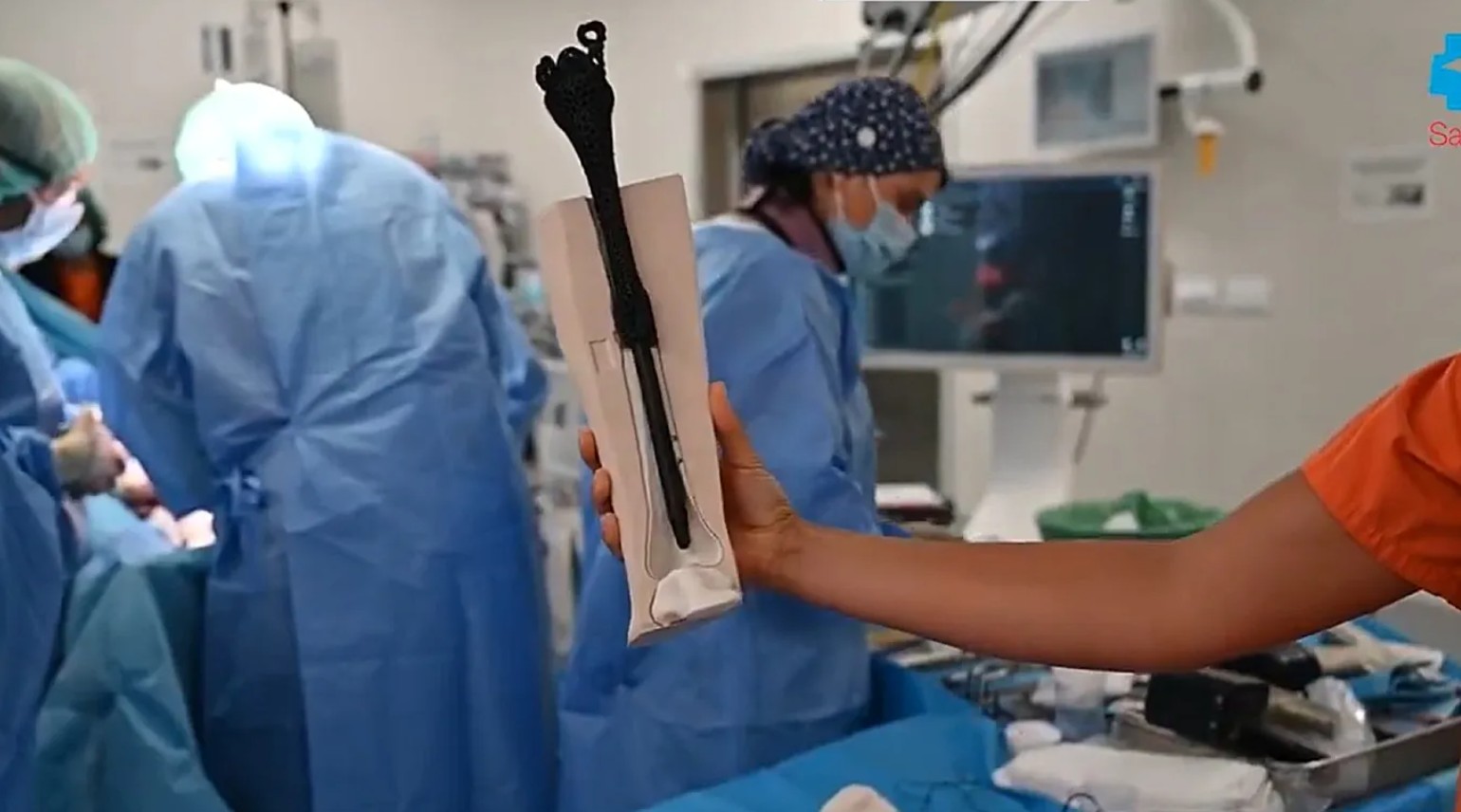
Spain-based Gregorio Marañón Hospital has avoided the amputation of a leg to a 38-year-old patient suffering from a high-grade bone sarcoma in his tibia. To do so, the team at the hospital used a custom-made bone implant, in titanium.
The medical team reached the point to design a custom implant after he had an infection and severe loss of bone density. His leg was no longer able to support a standard prosthesis.
For the manufacturing phase, clinicians worked with engineers from the Polytechnic University of Madrid (UPM). The patient’s radiological images enabled the team to create a digital twin of the healthy leg and simulated the loads the tibia could withstand when walking, climbing stairs or stumbling.
The data collected serves to design the prosthesis’s internal structure and position the screws in the areas with the strongest bone quality, enabling them to plan the surgery with greater accuracy.
The prosthesis would be made up of a network of millimeter-scale titanium structures designed to distribute loads in a similar way to bone tissue.
The implant is reported to weigh just 300 grams, yet simulations show it can withstand over 500 kilos; far beyond conventional prostheses, which weigh several kilos and support only 100–150 kilos.
A year after the operation, the patient is already able to walk. Following nearly two years without loading the leg, he reports that he is now regaining mobility. Gregorio Marañón Hospital has completed a second similar procedure and is preparing two further personalized implants, one for the wrist and another for the sternum. The objective is to deploy this technology more widely to support hyper‑personalised medicine within the public health system.
*We curate insights that matter to help you grow in your AM journey. Receive them once a week, straight to your inbox. Subscribe to our weekly newsletter.